

For Taiwanese families and entrepreneurs, the EB-5 Immigrant Investor Program has long been one of the most reliable and flexible paths to U.S. permanent residency. No job offer, no employer sponsorship, no language test—just a qualifying investment that creates American jobs and a well-documented source of funds.
In 2025, the core appeal of EB-5 remains intact, but the practical realities have shifted dramatically. The unreserved visa category is officially capped for the fiscal year, reserved set-aside visas are still widely available (and under-utilized), and USCIS scrutiny on source-of-funds has reached new heights.
Below is the most comprehensive, up-to-date guide written specifically for Taiwanese investors navigating EB-5 right now.
The EB-5 Landscape for Taiwanese Investors
Taiwanese investors have long had relatively favorable access to the EB-5 program, with lower visa backlogs compared to some other countries.
But in 2025, the landscape is more complex: competition for reserved visa categories has increased, and the unreserved category has reached its cap for the fiscal year, according to the U.S. Department of State.
Key Updated Figures & Regulatory Changes (2025)
Here are the most important updates that Taiwanese EB-5 investors should factor into their planning for 2025:
Investment Minimums: The EB-5 Reform and Integrity Act of 2022 (RIA) sets the investment at US$1,050,000 for standard (non-TEA) projects and US$800,000 for TEA (Targeted Employment Area) or infrastructure projects.
TEA Definition & Designation: TEAs now include rural areas and high-unemployment areas (where the unemployment rate in the relevant census tracts is at least 150% of the national average).
TEA Certificate Validity: Under the RIA, TEA certificates are valid for two years from the date of application.
Visa Set-Asides: The RIA reserves a portion of EB-5 visas each fiscal year for specific project types: 20% for rural, 10% for high-unemployment, and 2% for infrastructure.
Inflation Adjustments: The minimum investment amounts (US$800K and US$1,050K) are indexed to the Consumer Price Index (CPI-U) and will be adjusted every five years.
Visa Availability & Backlog- What’s New in 2025
Unreserved Category Cap Reached: As of September 2025, the annual limit for unreserved EB-5 visas has been reached. The U.S. Department of State has paused further issuances in this category until the next fiscal year.
Reserved Categories Still Open: Fortunately, the reserved set-aside categories (rural, high-unemployment, infrastructure) remain open.
Under-Utilization of Reserved Visas: According to IIUSA, visa issuance in these reserved categories has been low- in early 2025, only 2% of rural and 5% of high-unemployment set-aside visas were used in some months.
Implication for Investors: Because the unreserved quota is full, Taiwanese investors may increasingly favor EB-5 projects that qualify for reserved visa categories, particularly rural or infrastructure projects, to avoid delays.
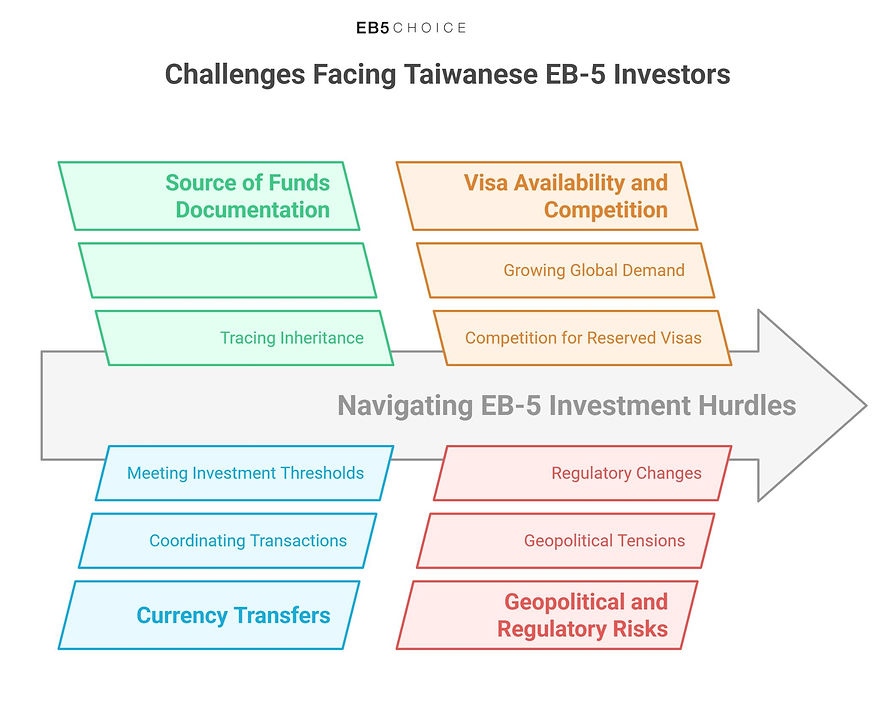
Challenges Facing Taiwanese Investors (Updated for 2025)
Source of Funds Documentation:
Proving the lawful source of investment funds is a cornerstone of the EB-5 process. Taiwanese investors often face challenges in documenting the origin of their investment due to the need for extensive financial records and transparency requirements.
Challenges include:
Tracing inheritance, real estate sales, or business profits across multiple years.
Meeting USCIS standards for detailed documentation and explanations.
Translating and notarizing documents to comply with U.S. regulations.
Currency Transfers:
While Taiwan does not have the strict foreign exchange controls seen in other regions, transferring large sums of money for EB-5 investments still requires careful planning. Investors may need to coordinate multiple transactions to meet the $800,000 minimum investment requirement for targeted employment area (TEA) projects.
Visa Availability and Global Competition:
Taiwanese investors currently benefit from a shorter backlog compared to Chinese investors, but growing global demand for EB-5 visas could impact wait times. Competition for projects offering reserved visas under the EB-5 Reform and Integrity Act of 2022, such as rural, high-unemployment, or infrastructure of the EB-5 projects, has increased, requiring investors to act decisively.
Geopolitical and Regulatory Risks:
While Taiwan’s strong relationship with the U.S. provides stability for EB-5 investors, geopolitical tensions in the region could introduce uncertainties.
Policy Volatility: While Taiwan–U.S. relations remain stable, any U.S. policy change (on EB-5, TEA designations, or visa quotas) could materially affect Taiwanese investors.
TEA Risk: Since TEA designations are done at the federal level (DHS) and subject to renewal, project TEA status should be verified carefully. (source)
How Taiwanese Investors Can Navigate EB-5 Challenges
Start Early and Be Proactive:
The earlier you begin the EB-5 process, the better positioned you’ll be to manage challenges like processing times or visa availability. Early planning also allows time for thorough due diligence on projects and proper documentation of your source of funds.
Focus on Reserved Visa Categories:
The EB-5 Reform and Integrity Act of 2022 created reserved visas for rural, high-unemployment, and infrastructure projects. These categories can reduce wait times and help Taiwanese investors secure visas more quickly. Partnering with trusted professionals can help identify projects that meet these criteria.
Thoroughly Document Your Source of Funds:
Work with experienced professionals to ensure your financial documentation is complete and compliant. USCIS requires a clear and detailed paper trail for all funds used in the investment, which may include tax returns, business financials, or proof of asset sales. This detailed paper trail is known as source of funds in the EB-5 Investment Program.
Work with Trusted Professionals:
Partnering with experienced EB-5 attorneys and EB-5 broker dealers, financial advisors, and Regional Centers is essential to navigating the complexities of the program. These experts can provide tailored guidance to help Taiwanese investors meet regulatory requirements and choose projects aligned with their goals.
Stay Updated on Visa Bulletin:
Closely monitor the U.S. Visa Bulletin and reserved-category demand; reserved categories continue issuing visas, though utilization has been low.
Why Choose EB-5 Choice?
At EB-5 Choice, we have extensive experience helping Taiwanese investors successfully navigate the EB-5 program. We understand the unique challenges you face and are committed to guiding you every step of the way—from source-of-funds documentation to selecting a compliant project that aligns with your goals.
Our team of expert EB-5 investment advisors can also provide insights into how the EB-5 program fits within the broader context of U.S.-Taiwan relations, ensuring you are well-prepared for any geopolitical or regulatory changes that may arise.
Final Thoughts
For Taiwanese investors, the EB-5 program is an excellent opportunity to secure US permanent residency by investment, but success requires careful planning and informed decision-making. Understanding the unique challenges of the program, such as source-of-funds documentation and competitive project selection, is critical to achieving your immigration and investment goals.
At EB-5 Choice, we are here to support you in every aspect of your EB-5 journey. Contact us today to learn how we can help you navigate the program with confidence and make the most of this unique opportunity. Want a smooth path to U.S. residency? EB-5 Choice helps Taiwanese investors navigate the EB-5 process with confidence. Contact us today to get started!