

Entering the EB-5 Investor Program often requires significant capital, and many investors face the choice between using a secured loan or an unsecured loan to fund their EB-5 investment. Understanding the differences between secured and unsecured loans is essential for EB-5 investors looking to maximize their chances of success while minimizing risks and complications.
This guide will explore the key aspects of secured loan vs unsecured loan for EB-5, providing clarity on which option might be better suited for different investor profiles and conditions in 2025.
Why Loan Type Matters for EB 5 Investors
The EB-5 program requires investors to prove that all invested capital was obtained lawfully. This means the burden of proof is on the applicant. If your documentation is incomplete or the loan terms appear weak or unsupported, your petition could face delays or denials.
Loan structure also affects:
The amount of evidence you must provide
The risk of a USCIS request for evidence
The likelihood of final approval
The financial security behind your investment
The strength of your immigration strategy overall
Investors often underestimate how deeply USCIS analyzes loan-related records. This is why having a strong grasp of each loan type can make the process far smoother. (source)
For a clear breakdown of how USCIS reviews loan documentation, see our EB-5 path of funds guide.
What is a Secured Loan for EB-5?
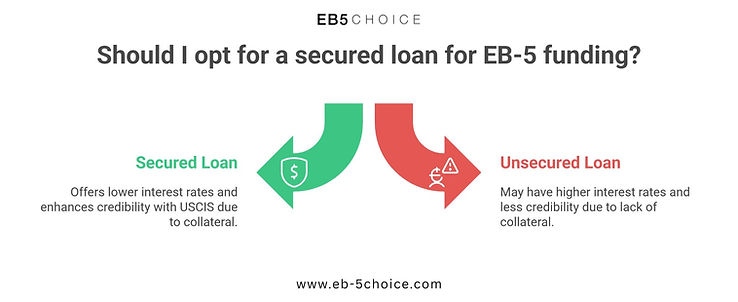
A secured loan for EB-5 funding is a loan backed by collateral, which is typically the borrower’s property, assets, or other valuable guarantees. Collateral provides the lender with security against the loan amount, reducing the lender’s risk. If the borrower defaults, the lender can seize the collateral to recoup losses.
Because of the collateral, secured loans often come with lower interest rates and more favorable terms compared to unsecured loans.
For EB-5 investors, secured loans can enhance the credibility of the investment funds in the eyes of United States Citizenship and Immigration Services (USCIS). The collateral must be proven to be lawfully obtained and properly documented to meet the program’s requirements.
The loan agreement should clearly outline the terms, repayment schedules, and responsibilities of the borrower to strengthen the application. Many EB-5 regional centers encourage or require investors to opt for secured loans due to this added financial transparency.
What is an Unsecured Loan in the EB-5 Context?
An unsecured loan carries no collateral backing; it is granted primarily based on the borrower’s creditworthiness and the promise to repay. Unsecured loans tend to be harder to obtain for the amounts required by EB-5 programs, and they often come with higher interest rates, reflecting the increased risk to lenders.
Despite these challenges, unsecured loans are permissible sources of funds for EB-5 investments when properly documented. USCIS requires investors to show the loan agreement, evidence of funds disbursement, and proof of borrower responsibility for repayment.
This documentation must clearly prove the legitimacy and “at risk” nature of the investment- meaning the investor must bear the risk of loss regardless of the loan terms.
Comparing Secured Loan vs Unsecured Loan for EB-5
Feature | Secured Loan | Unsecured Loan |
Collateral Requirement | Yes, backed by assets or property | No collateral needed |
Interest Rates | Generally lower due to lower risk | Higher due to increased lender risk |
Loan Availability | More common for large EB-5 amounts | Harder to find for large EB-5 investments |
USCIS Scrutiny | Requires proof of lawful source for collateral | Requires strong documentation and proof of repayment responsibility |
Application Complexity | More documentation for collateral valuation | Simpler documentation but must prove repayment ability |
Risk to Investor | Risk of losing collateral in case of default | Personal liability without risk to property |
If you want to explore loan structures used successfully in real EB-5 cases, see our full guide on loans for EB-5 investments.
Legal and USCIS Considerations
USCIS allows both secured and unsecured loans to fund EB-5 investments provided the funds meet lawful source and “at risk” conditions. The investor must show that the loan funds were lawfully acquired and that repayment responsibility is clearly established.
With a secured loan, additional evidence is required to prove the lawful acquisition of collateral. Unsecured loans streamline this by removing collateral concerns but attract closer attention to loan agreements and repayment commitments.
Both loan types must demonstrate that the investor faces actual financial risk, a critical EB-5 program requirement.
Choosing the Right Loan Type for Your EB-5 Investment
Several factors influence whether a secured or unsecured loan is more appropriate for EB-5 funding:
If you have valuable assets to pledge as collateral and want to secure lower interest rates, a secured loan is typically preferable.
If you lack significant collateral but have a strong credit profile and can document a clear repayment plan, an unsecured loan can be workable.
Consider your risk tolerance – secured loans risk loss of assets upon default, whereas unsecured loans pose personal liability without collateral seizure.
Consult with EB-5 regional centers and immigration attorneys who specialize in investor program financing to tailor the loan structure best suited for your goals to become a permanent resident in America.
Integrating Loans in US Permanent Residency Planning
Effective financing strategies including careful selection of loan type can improve the probability of visa approval under the EB-5 program. Investors pursuing US permanent residency by investment must ensure their funding sources comply with the complex USCIS requirements to avoid delays or rejections.
Loans must be used in a way that aligns with the EB-5 program’s emphasis on job creation and economic impact. Regional centers assist investors by offering structured projects where loans can be safely integrated into capital stacks without jeopardizing the investor’s ability to meet program guidelines.
Investors should weigh loan terms carefully and consider long-term financial planning, especially since obtaining a green card through EB-5 typically leads to permanent changes in tax status and liability.
Final Thoughts on Secured Loan vs Unsecured Loan for EB-5
Navigating the choice between secured and unsecured loans for EB-5 investments involves understanding both financial implications and USCIS requirements. Secured loans offer more security and potentially lower costs but require verifiable collateral and documentation.
Unsecured loans may be more flexible but demand rigorous evidence of repayment ability and incur higher costs.
Ultimately, the best choice depends on the investor’s financial circumstances, risk tolerance, and immigration goals. Engaging knowledgeable EB-5 regional centers and legal advisors is essential to structuring compliant, effective funding arrangements.
Ready to structure your EB-5 investment correctly? Contact us today for expert assistance.