


If you filed an EB-5 petition, or you’re weighing whether to file one before September, the EB-5 Visa Bulletin For August 2026 is worth a close read. It’s the last bulletin of fiscal year 2026, and it lands at a moment when demand for immigrant visas is running high across nearly every employment-based category. For some investors, that’s good news.
For others, particularly those in backlogged unreserved categories, it’s another month of waiting.
This guide breaks down what the Visa Bulletin August release actually says, what it means for your priority date, and what to expect once the government’s new fiscal year opens on October 1.
What the EB-5 Visa Bulletin For August 2026 Covers
Each month, the U.S. Department of State publishes the Visa Bulletin to tell immigrant visa applicants where they stand in line. For August, U.S. Citizenship and Immigration Services has instructed employment-based applicants, including EB-5 investors, to use the Final Action Dates chart (Chart A) when filing for adjustment of status.
Family-sponsored applicants follow a different chart, the Dates for Filing (Chart B), so it’s worth double-checking which chart applies to your case before you file anything.
The distinction matters. Final Action Dates tell you when a green card can actually be approved. Dates for Filing only tell you when you’re allowed to submit an application and start the process. Applicants should always verify which chart USCIS has designated for the relevant month before filing.
Why August Matters More Than a Typical Month
August is the second-to-last bulletin before the fiscal year closes on September 30, 2026. Visa numbers are allocated annually, and once a category’s yearly limit is reached, no further approvals happen until the next fiscal year begins. That’s part of why this month’s bulletin includes warnings about categories that could become unavailable before October, and why investors weighing whether to file now are watching the calendar closely.
EB-5 Visa Availability in August 2026
The EB-5 program operates on two separate tracks, a structure created by the EB-5 Reform and Integrity Act of 2022 (RIA). Understanding which track your petition falls into is the single most important factor in reading your own EB-5 immigration timeline correctly, while choosing the best EB-5 regional center is also an important part of evaluating an EB-5 investment opportunity.
Reserved EB-5 Categories (Set-Asides)
Three set-aside categories exist under the RIA:
- Rural projects (20% of the annual EB-5 allocation)
- High Unemployment Area projects (10%)
- Infrastructure projects (2%)
All three remain listed as Current for every country of chargeability this month, including China and India. Because “Current” appears on the Final Action Dates chart, investors in these categories who are already in the U.S. on a valid nonimmigrant visa can file concurrent adjustment of status applications. In practice, that means submitting the I-485 alongside employment authorization and travel permit requests, rather than waiting years for a visa number to clear first.
Reserved EB-5 categories can offer investors more predictable visa availability. For an Indian EB-5 investors, for example, filing into a rural TEA project through the reserved category is currently a far faster path to a green card than the unreserved route described below. Before choosing a rural project, investors should understand the key factors involved in project selection.
Unreserved EB-5 Category
The unreserved category covers petitions filed before the RIA took effect, along with projects located outside a designated Targeted Employment Area. Here, the picture looks very different depending on where an investor was born:
| Country | Final Action Date | Dates for Filing |
| China (mainland) | December 1, 2016 | March 1, 2017 |
| India | Unavailable | May 1, 2024 |
| Rest of world (including Mexico, Philippines) | Current | Current |
China’s unreserved Final Action Date has not moved this month, which means only investors whose priority date falls on or before December 1, 2016 are eligible for green card approval right now. India’s unreserved category is listed as Unavailable, meaning the annual limit for Indian unreserved applicants has already been used up for FY 2026.
Both countries are expected to see fresh visa numbers open up on October 1, 2026, once FY 2027 begins.
Broader Employment-Based Trends Worth Watching
EB-5 doesn’t move in isolation. Because all employment-based categories draw from a shared pool of visas, pressure in one category can ripple into others. A few developments stand out this month:
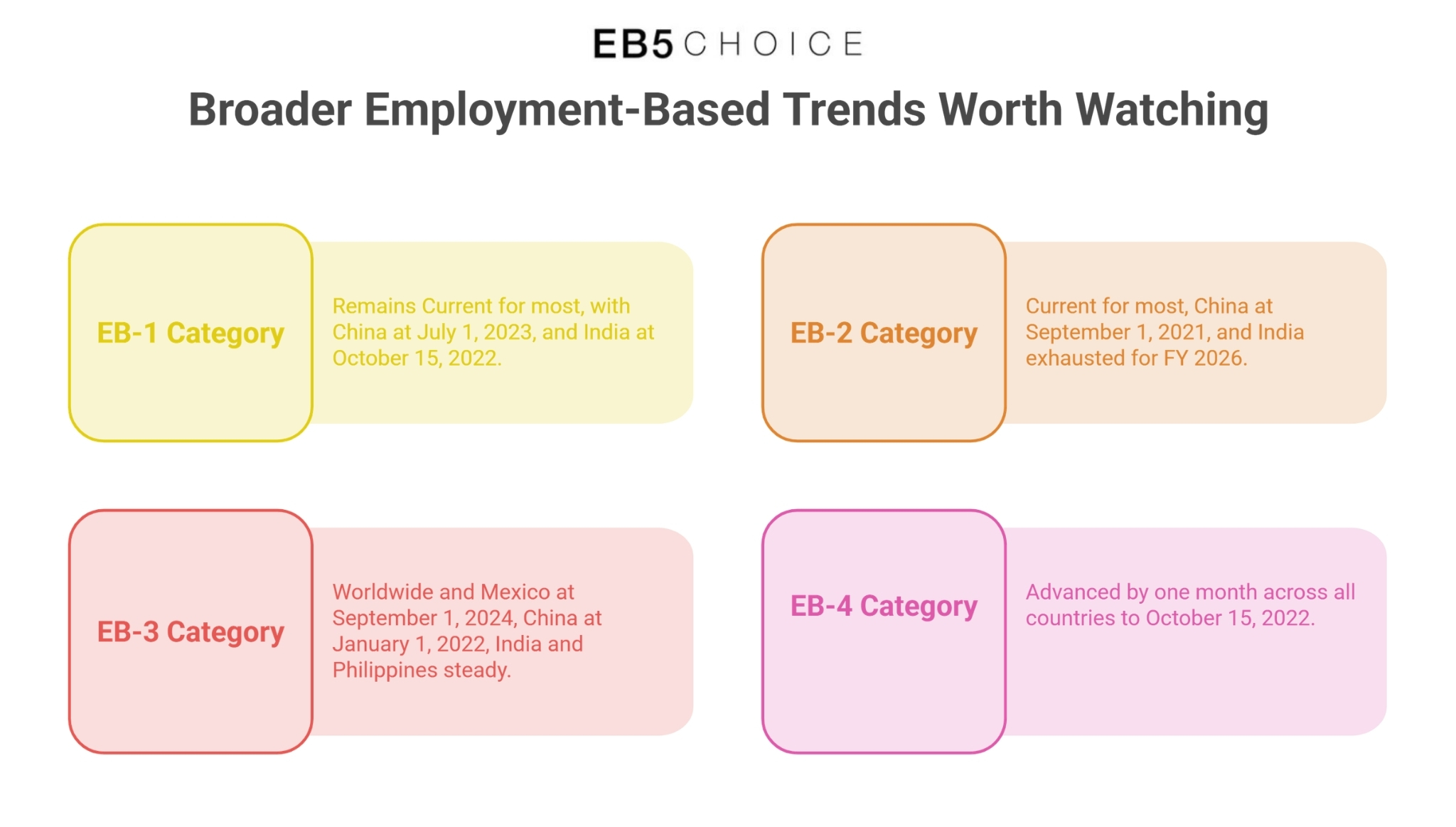
- EB-1 remains Current for most of the world, but China’s Final Action Date advanced to July 1, 2023, and India’s date held at October 15, 2022, with a warning that the category could become unavailable for Indian applicants if demand outpaces the remaining pro-rated limit before September 30.
- EB-2 stayed Current for most countries, with China at September 1, 2021. India’s EB-2 category, however, is fully exhausted for the rest of FY 2026, a reminder of how quickly high-demand categories can hit their annual ceiling.
- EB-3 advanced modestly across the board: worldwide and Mexico moved to September 1, 2024, China ticked forward ten days to January 1, 2022, and India and the Philippines held steady.
- EB-4 advanced by one month across all countries, landing at October 15, 2022.
Source: U.S. Department of State Visa Bulletin (August’2026)
How Priority Dates and Deadlines Affect Investors
What a Priority Date Actually Determines
Your priority date is typically the date your initial I-526 or I-526E petition was filed. Think of it as your place in a queue that only moves forward when the government issues new visa numbers, either monthly, as small advances, or annually, at the start of a new fiscal year. When your priority date falls on or before a category’s Final Action Date, you’re eligible to have your green card approved.
For investors planning beyond permanent residency, the EB-5 process can also provide a path toward naturalization after meeting the applicable requirements.
To understand the long-term journey, learn more through our detailed guide on US citizenship through the EB-5 program.
Current vs. Unavailable, in Plain Terms
A category marked Current means there’s no backlog at all, every qualified applicant can move forward. A category marked Unavailable means the opposite: the annual cap has been hit, and nothing more will be approved in that category until the next fiscal year resets the count. For India’s unreserved EB-5 applicants this year, that reset arrives October 1.
The Grandfathering Deadline: September 30, 2026
September 30, 2026, is important because it marks the end of fiscal year 2026. It is not, based on the current RIA authorization, a general deadline for filing an I-526E petition to receive EB-5 grandfathering protections.
The Regional Center Program is currently authorized through September 30, 2027. Investors should therefore avoid treating September 30, 2026, as a universal EB-5 filing deadline without case-specific legal guidance. (Source)
What Changes on October 1, 2026
The start of FY 2027 resets the annual visa count. For categories that ran out of numbers this year, most notably India’s EB-2 and the unreserved EB-5 categories for China and India, October 1 is when new visa numbers become available again. It won’t clear years of backlog overnight, but it does mean movement resumes after months of being stuck at Unavailable.
Practical Takeaways for Investors
- Check which category you’re in before assuming you’re stuck. An investor filing into a reserved (set-aside) project sees a completely different timeline than one filing into the unreserved category, even from the same country.
- Don’t confuse the two charts. Final Action Dates control approvals this month; Dates for Filing only controls who can submit paperwork.
- If you’re close to filing, September 30 is a real deadline, not a soft suggestion. Grandfathering protections apply to petitions filed by that date.
- Watch October 1 for movement, especially if you’re an Indian investor in the unreserved category or EB-2.
- Talk to an immigration attorney or an EB-5 broker dealer before making filing decisions. Visa Bulletin analysis explains the landscape, but it is not a substitute for case-specific legal advice
Final Thoughts
The August 2026 Visa Bulletin captures a program in transition: reserved categories running smoothly while the unreserved line remains a bottleneck for China and India, all against the backdrop of a fiscal year-end deadline that carries real legal consequences. Whether you’re deciding when to file, tracking an existing priority date, or trying to understand what October 1 will bring, the details in this bulletin are worth acting on rather than just reading.
Ready to map out your own EB-5 timeline? EB-5 Choice can help you better understand your options and connect you with qualified EB-5 professionals who can help you understand where your priority date stands and what your options are heading into FY 2027
Contact EB-5 Choice Today.
Frequently Asked Questions
What is the EB-5 Visa Bulletin For August 2026?
It’s the U.S. Department of State’s monthly publication showing which EB-5 categories and countries have visa numbers available for August 2026. It tells investors whether they should use the Final Action Dates or Dates for Filing chart, and where their priority date stands.
Is EB-5 visa availability the same for every country?
No. Reserved (set-aside) EB-5 categories are Current worldwide this month. The unreserved category, however, is backlogged for mainland China and listed as Unavailable for India.
What does “Unavailable” mean on the Visa Bulletin?
It means the annual visa limit for that category and country has already been reached. No further approvals happen until the next fiscal year begins on October 1.
Why is September 30, 2026 important for EB-5 investors?
It’s the deadline to file an I-526E petition and still qualify for grandfathering protections under the 2022 EB-5 reform law, which protect an investor’s ability to finish the process even if program rules change later.
What’s the difference between reserved and unreserved EB-5 categories?
Reserved categories (Rural, High Unemployment, Infrastructure) were created by the 2022 EB-5 reform law and receive set-aside visa allocations, currently Current for all countries. Unreserved covers older petitions and projects outside targeted employment areas, and is subject to per-country backlogs.
Which Visa Bulletin chart should EB-5 applicants use in August 2026?
For August 2026, USCIS instructed employment-based applicants, including EB-5 investors, to use Chart A (Final Action Dates) to determine eligibility for green card approval and adjustment of status filings.
What is the difference between “Final Action Dates” and “Dates for Filing”?
Final Action Dates (Chart A): Indicates when an immigrant visa is officially available and a green card application (I-485 or consular processing) can be fully approved.
Dates for Filing (Chart B): Indicates when applicants are allowed to submit their initial paperwork to get into the processing queue, even if a final visa is not yet available.
What are the reserved EB-5 categories under the Reform and Integrity Act (RIA)?
The EB-5 Reform and Integrity Act of 2022 created three reserved (set-aside) visa categories:
Rural Projects: 20% of the annual allocation
High Unemployment Area (TEA) Projects: 10% of the annual allocation
Infrastructure Projects: 2% of the annual allocation
Can I file Concurrent Adjustment of Status (I-485) in August 2026?
Yes, but only if your specific category and country of chargeability are marked as Current on Chart A. Investors in the U.S. on valid nonimmigrant visas who apply under reserved EB-5 categories (Rural, High Unemployment, Infrastructure) can file their I-485 concurrently with their I-526E petition.
What happens to backlogged EB-5 visa categories on October 1, 2026?
October 1, 2026, marks the start of U.S. Government Fiscal Year 2027 (FY 2027). On this date, annual visa counts reset, making fresh visa allocations available for exhausted categories like India Unreserved EB-5 and India EB-2.
What is a priority date in the EB-5 program?
A priority date is the date USCIS receives an investor’s initial petition (Form I-526 or I-526E). It reserves the investor’s place in line for a green card. An applicant can only receive a green card when their priority date is earlier than or equal to the Final Action Date published in the Visa Bulletin.
How do backlogs in EB-1, EB-2, and EB-3 affect EB-5 investors?
All employment-based green card categories share an overall statutory ceiling. Spillover visas from unused EB-1 or EB-2 categories can sometimes flow into other categories. When high-demand categories like EB-2 become exhausted, applicants often look to alternative pathways like EB-5 set-aside categories.