

The Cost To Apply For US Citizenship in 2026 for most applicants is $760 in total government fees, which includes a $675 filing fee for Form N-400 and an $85 biometrics fee. However, depending on your immigration pathway, your total investment could range from a few hundred dollars to well over a million.
This guide breaks down every cost you need to know before you begin.
Understanding the True Cost To Apply For US Citizenship in 2026
Most people think of citizenship costs as a single government form fee. In reality, the financial picture is layered. Your pathway to citizenship determines your total expense more than any single filing.
The standard route to citizenship is naturalization, which requires you to first hold a Green Card (lawful permanent residence) for either three or five years, depending on your situation. But before you ever fill out Form N-400, you have likely already spent thousands on prior immigration filings, legal fees, translation services, and documentation.
Here is a clear breakdown of what the naturalization process costs directly:
Fee Item | Cost (2026) |
Form N-400 Filing Fee | < $800 |
Biometrics Fee | $85 |
Document Translation (per document) | $50 to $150 |
Passport Photos | $15 to $25 |
Medical Records / Supporting Docs | $50 to $300 |
Estimated Total | $1,675 to $4,085+ |
Fee waivers are available for applicants who meet income-based eligibility criteria. USCIS Form I-912 is used to request a fee waiver for the N-400, and approval is based on your household income relative to federal poverty guidelines.
For a complete breakdown of every fee involved in the EB-5 process, see our dedicated guide: What Does the EB-5 Program Actually Cost
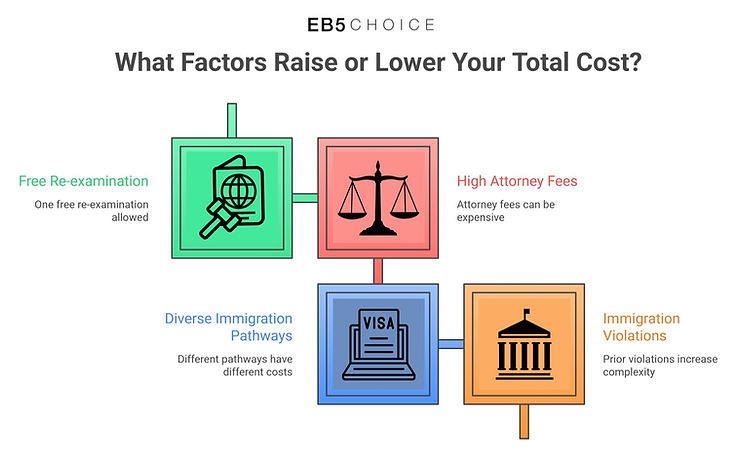
What Factors Raise or Lower Your Total Cost?
Several variables affect how much you will actually spend on your path to US citizenship.
Your Immigration Pathway
Not everyone arrives at citizenship the same way. Employment-based immigrants, family-sponsored immigrants, refugees, asylees, and diversity visa lottery winners all follow different tracks with different associated costs. Someone who entered on an H-1B visa and later obtained a Green Card through employer sponsorship will have spent significantly more than someone who came as the spouse of a US citizen.
Whether You Use an Immigration Attorney
Hiring an attorney is not legally required for naturalization, but it is strongly advisable if your case involves prior immigration violations, criminal history, extended absences from the US, or complex tax situations.
Attorney fees typically range from $800 to $3,000 for a standard naturalization case, though complex cases can cost more.
Translation and Documentation Costs
USCIS requires all foreign-language documents to be accompanied by certified English translations. If you were born abroad, married abroad, or have foreign court records, each document translation can cost $50 to $150.
These costs add up quickly for applicants with extensive foreign documentation.
Retaking the Civics Test or Interview
If your application is denied or you fail the civics or English test on the first attempt, you are entitled to one free re-examination within 60 to 90 days. However, if your overall application is denied and you must refile, you pay the full filing and biometrics fees again.
How Much Does It Cost To Apply For US Citizenship Through the EB-5 Program?
For foreign nationals who do not have a qualifying family relationship or employer sponsorship, investment-based immigration is one of the few direct routes to permanent residency, and eventually citizenship. The EB-5 Immigrant Investor Program is the most prominent of these pathways.
Under current program rules, EB-5 investors must contribute a minimum of $1,050,000 in a standard investment, or $800,000 if the investment is made in a Targeted Employment Area (TEA), which is a rural or high-unemployment region. These capital amounts do not include additional fees.
Those pursuing US citizenship through the EB-5 program should budget for the following beyond the capital investment itself:
I-526E Petition Filing Fee: $4675
DS-260 or Adjustment of Status (I-485): $1,440 (including biometrics)
I-829 Petition to Remove Conditions: $3,750
EB-5 Regional Center program fees: $50,000 to $70,000 in administrative charges, depending on the project
What Are EB-5 Regional Centers and How Do They Affect Cost?
Rather than investing directly in a new business enterprise, most EB-5 investors participate through EB-5 regional centers, which are USCIS-designated entities that pool investor capital for large commercial or real estate development projects. Regional centers handle project management, job creation tracking, and regulatory reporting on behalf of investors.
While regional center participation simplifies the investor’s role, it does come with additional costs. Investors typically pay administrative fees of $50,000 to $70,000 on top of their required capital contribution. These fees cover the regional center’s operational expenses, legal compliance, and fund management.
When choosing a regional center, investors are increasingly working with a qualified EB-5 broker dealer, a FINRA-registered securities professional who helps vet investment offerings, assess risk disclosures, and ensure compliance with US securities law.
Broker dealer fees vary, but typically range from 1% to 3% of the total capital raise, and are often paid by the project developer rather than the individual investor.
Due diligence matters enormously here.
Not all regional center projects carry the same risk profile or track record. Investors should request audited financials, independent legal review, and full disclosure of all fees before committing capital.
Not sure whether a regional center is right for you? Read: Why Most EB-5 Investors Choose Regional Centers
Comparing the Main Citizenship Pathways by Cost
Pathway | Estimated Total Cost |
Naturalization (via family Green Card) | $1,500 to $4,500 |
Naturalization (via employment Green Card) | $5,000 to $20,000+ |
Naturalization via EB-5 Direct Investment | $900,000 to $1,200,000+ |
Naturalization via EB-5 Regional Center | $950,000 to $1,500,000+ |
Naturalization via Diversity Visa | $1,500 to $4,500 |
These figures represent total out-of-pocket costs from initial immigration application through final naturalization. They do not account for income, taxes, or return on investment in EB-5 cases.
Common Challenges and Hidden Costs to Watch For
Delays and Refiling:
USCIS processing times for Form N-400 currently average 8 to 14 months, though this varies by field office. Delays do not add direct costs, but if your circumstances change during a prolonged wait (such as extended travel abroad or a change in marital status), you may need additional legal counsel to address complications.
Biometric Reschedules:
If you miss your biometrics appointment and need to reschedule, USCIS charges a rescheduling fee, and repeated no-shows can result in application abandonment.
State and Local Fees:
Once you receive citizenship, obtaining a US passport costs $130 for adults. Some states also charge fees for obtaining new state identification documents that reflect your citizenship status.
Tax Compliance for EB-5 Investors:
For those who obtained permanent residency through an investment route, US tax obligations begin from the date of Green Card approval. This includes worldwide income reporting, FBAR requirements for foreign accounts, and potentially complex capital gains treatment on the EB-5 investment itself. Dedicated international tax counsel is a practical necessity and an additional ongoing cost.
Practical Advice Before You File
Prepare your documents well in advance. USCIS is strict about incomplete applications, and a returned or rejected filing does not refund your fees. Make certified copies of every document and keep a complete personal filing record.
If you are applying through naturalization and have traveled outside the US for periods longer than six months, document your reasons carefully. Extended absences can interrupt the continuous residence requirement and potentially delay your eligibility date, which pushes back your application and costs you time.
For investment-based applicants, engage an immigration attorney who specializes in EB-5 before selecting a project. The legal complexity of the EB-5 process and the scale of capital involved make independent professional advice non-negotiable.
Frequently Asked Questions: Applying for US citizenship in 2026
What is the filing fee to apply for US citizenship in 2026?
The base filing fee for Form N-400, the Application for Naturalization, is $675 in 2026. An additional $85 biometrics fee applies to most applicants between the ages of 14 and 78. This brings the standard government fee total to $760. Fee waivers are available for eligible low-income applicants.
Can I apply for US citizenship for free?
You may qualify for a full fee waiver if your household income is at or below 150% of the federal poverty guidelines, or if you receive certain means-tested public benefits. Submit Form I-912 alongside your N-400 to request a waiver. Approval is not guaranteed and USCIS will review your financial documentation carefully.
How long does it take and what ongoing costs should I expect during the process?
The naturalization process currently takes between 8 and 18 months from filing to ceremony, depending on your USCIS field office. During this period, you may incur costs for attorney consultations, additional document requests, and transportation to your biometrics appointment and interview. Budget at least $200 to $500 in miscellaneous costs beyond your filing fees.
Is the EB-5 investment refundable if my application is denied?
The capital invested through EB-5 is not a fee paid to the government. It is an at-risk investment in a commercial enterprise. If your I-526E petition is denied, whether and how your capital is returned depends entirely on the terms of your investment agreement with the project developer or regional center. This is why legal and financial due diligence before investing is critical.
Do children automatically become US citizens and do they pay separate fees?
Children who are lawful permanent residents and are under 18 when their parents naturalise may automatically acquire US citizenship under the Child Citizenship Act of 2000.
In those cases, no separate N-400 application or filing fee is required for the child. You can obtain a Certificate of Citizenship (Form N-600) for the child for $1,170, though possession of the certificate is not legally required to prove citizenship.
Conclusion
The cost to apply for US citizenship in 2026 depends entirely on your starting point. For most naturalization applicants, the government fees are manageable at $760, with total costs reaching $1,500 to $4,000 when you include documentation and optional legal help.
For those pursuing residency through investment, the total financial commitment rises dramatically, often exceeding seven figures when capital requirements, program fees, and legal costs are combined.
Regardless of your pathway, the single most valuable investment you can make is in accurate, expert guidance before you file. Immigration law changes frequently, USCIS fee schedules are updated periodically, and individual circumstances can dramatically alter both eligibility timelines and costs. Treat every dollar spent on qualified legal and financial advice as an essential part of the process, not an optional extra.