

Navigating the EB-5 immigrant investor program can feel overwhelming, especially when you’re preparing your I-526E petition for the first time. This crucial document serves as your gateway to obtaining permanent residency in the United States through investment. Whether you’re a seasoned entrepreneur or a first-time investor, understanding the preparation process can mean the difference between approval and costly delays.
In this comprehensive guide, we’ll walk you through every essential step of preparing your I-526 petition, from gathering documentation to avoiding common pitfalls that lead to denials.
Understanding the I-526E Petition Basics
The I-526E petition, officially known as the “Immigrant Petition by Alien Investor,” is the first major hurdle in your EB-5 journey. This form proves to United States Citizenship and Immigration Services (USCIS) that you meet all the requirements for the EB-5 visa program.
Your petition must demonstrate three critical elements.
You need to show that you’ve invested or are actively in the process of investing the required capital amount.
You must prove that your investment will create at least 10 full-time jobs for qualified U.S. workers. Third, you need to establish that your investment funds come from lawful sources.
Choosing Your Investment Path
Before diving into paperwork, you need to decide between two main investment routes: direct investment or investment through a regional center. This decision significantly impacts your petition preparation process.
Direct investment means you start or purchase your own business and directly manage job creation. While this gives you complete control, it also requires extensive documentation of your business plan, job creation methodology, and operational details. You’ll need to prove that your business will create exactly 10 qualifying jobs within two years of your conditional residence approval.
Alternatively, investing through an EB-5 regional center offers a more passive approach. Regional centers are USCIS-approved entities that sponsor EB-5 projects. When you invest through a regional center, you can count both direct and indirect job creation, making it easier to meet the 10-job requirement.
Regional centers typically handle much of the complex economic analysis and job creation calculations, though you still bear responsibility for proving your investment and source of funds.
Unsure which path suits you? Read: EB-5 Direct Investment vs Regional Center
Documenting Your Source of Funds
One of the most critical aspects of your I-526E petition is proving the lawful source of your investment capital. USCIS scrutinizes this section intensely to prevent money laundering and ensure program integrity.
You need to create a complete paper trail showing how you acquired your investment funds. The documentation must trace your wealth from its origin to the current investment. Essential documents include:
Tax returns from multiple years
Business ownership documents and salary statements
Property sale records or inheritance documentation
Gift letters with supporting evidence
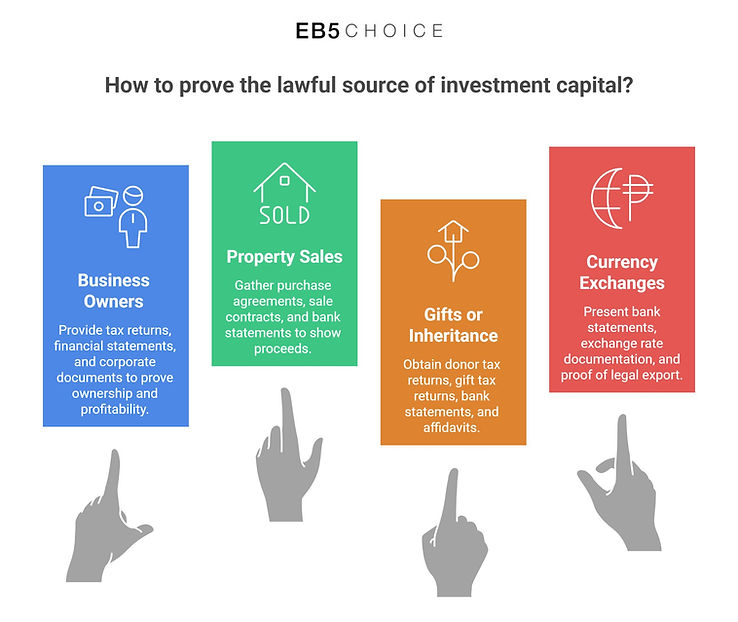
The documentation required varies depending on how you originally acquired your investment funds:
For Business Owners: Prepare several years of tax returns, audited financial statements, and corporate documents proving your ownership stake and the company’s profitability.
For Property Sales: Gather purchase agreements, sale contracts, bank statements showing the proceeds, and property valuation documents.
For Gifts or Inheritance: You’ll need donor tax returns, gift tax returns (if applicable), bank statements showing the transfer, affidavits from the donor explaining the gift, and documentation of how the donor acquired their wealth. Yes, you must prove the lawfulness of gifted funds too.
For Currency Exchanges: Provide bank statements showing the exchange, official exchange rate documentation for the transaction dates, and proof that you followed all legal currency export requirements from your home country.
The key to success in this section is completeness and clarity. USCIS officers need to see an unbroken chain of custody for your funds from the moment you earned them to the moment they entered your EB-5 investment.
Want a deeper breakdown of the fund required? Read our guide on: Path of Funds
Preparing Your Business Documentation
Your investment must go into a legitimate commercial enterprise, and you need documentation proving this. The specific documents vary based on whether you’re pursuing direct investment or working with a regional center.
For direct investments, compile your comprehensive business plan (typically 40 to 60 pages), articles of incorporation or LLC operating agreement, business licenses and permits, lease agreements for business premises, and contracts with suppliers or customers. Your business plan should detail market analysis, competitive landscape, organizational structure, financial projections for at least five years, and a detailed job creation timeline.
Regional center investors need the regional center’s approval letter from USCIS, the private placement memorandum or offering documents, subscription agreement showing your investment commitment, operating agreement or partnership documents, and the economic impact study proving job creation.
The economic analysis typically uses USCIS-approved methodologies like RIMS II to calculate indirect and induced jobs.
Proving Job Creation
Job creation stands at the heart of the EB-5 program. Your petition must convincingly demonstrate that your investment will create or preserve at least 10 full-time positions for qualifying U.S. workers.
Qualifying employees must be U.S. citizens, lawful permanent residents, or other immigrants authorized to work in the United States. The positions must be full-time, meaning at least 35 hours per week. You cannot count yourself, your spouse, or your children as employees. Independent contractors generally don’t count unless under specific circumstances.
For direct investments, provide detailed organizational charts showing each position, job descriptions for each role, hiring timeline with specific dates, and if you’ve already hired employees, payroll records and I-9 forms. Consider getting a professional business plan writer who understands EB-5 requirements to help structure this section.
Regional center investors benefit from counting indirect and induced jobs created through economic multiplier effects. Your regional center should provide a comprehensive economic impact analysis prepared by a qualified economist.
This analysis uses your investment amount and the project’s business plan to calculate total job creation. Review this document carefully to ensure it meets USCIS standards.
Calculating Your EB-5 Return on Investment
While the primary goal of EB-5 is obtaining a green card, understanding your EB-5 return on investment is crucial for making informed decisions. Most regional center projects offer returns ranging from 0% to 5% annually, though some projects may offer higher returns depending on the structure.
Direct investments potentially offer unlimited returns since you own and operate the business. However, these returns come with higher risk and management responsibility. You’ll need to balance your financial expectations with immigration goals when choosing your investment path.
Remember that EB-5 is fundamentally an immigration program, not primarily an investment vehicle. Many investors accept lower financial returns in exchange for the certainty of green card approval and the long-term benefits of U.S. residency.
See how regional center returns actually work with our blog on Understanding Regional Center Investment Return
Working with Professional Advisors
Preparing an I-526E petition is complex enough that most successful applicants work with experienced professionals. Qualified EB-5 visa consultants, like EB-5 Choice can guide you through every step of the process, from initial planning to final submission.
They should review your entire petition before submission.
They can identify weak points, suggest additional documentation, and ensure compliance with current USCIS policies. These legal professionals stay updated on the latest regulatory changes and adjudication trends that could impact your case.
Regional center investors should thoroughly vet potential projects and centers. Look for centers with strong approval track records, experienced management teams, and transparent communication. The right choice for your needs balances immigration safety with reasonable financial returns.
Common Mistakes to Avoid
Many petition denials result from preventable mistakes. Here are the most critical errors to avoid:
Incomplete Source of Funds Documentation: USCIS wants to see the complete trail from original wealth generation to current investment, not just recent bank statements.
Insufficient Job Creation Evidence: Be specific about hiring timelines and position qualifications. Vague business plans with unrealistic projections raise red flags.
Missing or Uncertified Translations: Every foreign language document needs a certified English translation to avoid delays and Requests for Evidence.
Investing Before Petition Approval: Transferring all funds before I-526 approval can complicate matters if you’re denied and need to recover your investment.
Failing to Disclose Relevant Information: Disclose business failures, bankruptcies, or legal issues upfront with explanations rather than hoping they won’t be discovered.
After Submission: What to Expect
After submitting your petition, USCIS will send a receipt notice confirming they’ve received your package. Processing times for the I-526 petition vary significantly based on your country of birth, the USCIS service center handling your case, and current agency workload.
Investors from countries without visa backlogs typically see processing times between 12 to 36 months. However, investors from countries with heavy EB-5 demand (particularly China, Vietnam, and India) may face additional waiting periods due to visa availability limitations.
Dealing with a visa backlog? Read our blog on Navigating Visa Backlogs
During processing, USCIS may issue a Request for Evidence if they need additional documentation or clarification. Respond promptly and completely to any RFE. Missing the deadline or providing incomplete responses can result in denial.
Upon approval, you’ll receive an I-526E approval notice. This allows you to proceed to the next step: either adjusting status if you’re already in the United States or applying for an immigrant visa at a U.S. consulate abroad. Your journey toward obtaining a US green card through investment continues with these subsequent steps.
FAQ: I-526E Petition
What is the I-526E petition and who needs to file it?
The I-526E is the first form you file to get a U.S. green card through the EB-5 investor program. You submit it to USCIS to prove you qualify as an immigrant investor. Anyone seeking U.S. permanent residency through investment, whether through a direct business investment or a USCIS-approved regional center, must file the I-526E before anything else in the process.
What qualifies as a “full-time job” under EB-5 rules?
A qualifying EB-5 job must be at least 35 hours per week. The employee must be a U.S. citizen, lawful permanent resident, or work-authorized immigrant.
You cannot count yourself, your spouse, or your children. Independent contractors generally do not qualify. If you invest through a regional center, you can count both direct and indirect jobs calculated through USCIS-approved economic model.
How do I document the lawful source of my EB-5 investment funds?
You must build a paper trail that traces your money from where it was originally earned all the way to your EB-5 investment account. What you need depends on the source. Business owners need tax returns, audited financials, and corporate ownership records. Property sellers need purchase and sale contracts plus bank statements showing proceeds.
What happens after I submit my I-526E petition?
USCIS sends a receipt notice confirming they have your petition. Then you wait. Investors from countries with no visa backlog typically wait 12 to 36 months for a decision. Investors from China, Vietnam, and India often wait longer due to annual per-country visa limits. If USCIS needs more information, they will issue a Request for Evidence.
How long does USCIS take to process an I-526E petition in 2026?
Processing times for the I-526E petition in 2026 depend significantly on the investor’s country of birth. Investors from countries with no visa backlog. Investors born in high-demand EB-5 countries, particularly China, Vietnam, and India, may face substantially longer wait times because annual per-country visa caps limit how many applicants from those nations can advance per year.
Conclusion
Preparing your I-526E petition requires meticulous attention to detail, comprehensive documentation, and often months of preparation. While the process is demanding, thousands of investors successfully navigate it each year by following systematic approaches and working with qualified professionals.
Start early, stay organized, and don’t rush the documentation process. A well-prepared petition submitted after thorough preparation has a much higher approval rate than a hastily assembled package.
Remember that your I-526 petition is the foundation of your entire EB-5 journey. Investing time and resources in getting it right the first time saves significant stress, money, and delays down the road.