


The EB-5 Immigrant Investor Program provides foreign investors with a pathway to U.S. residency through qualifying investments. However, choosing the right project requires careful evaluation of market conditions and economic trends. Factors such as interest rates, inflation, real estate demand, and regional growth can directly impact project performance. These conditions influence development timelines, job creation, and overall financial stability. A strong market can support project success, while unfavorable conditions may increase risks. Understanding these factors helps investors make informed decisions and conduct effective due diligence. Ultimately, market analysis is essential for achieving both immigration and investment objectives.
Understanding the Relationship Between Market Conditions and EB-5 Investments
Market conditions refer to the economic factors and business trends that affect industries, businesses, and investment opportunities. These conditions shape how projects perform, how quickly they grow, and how effectively they achieve their objectives.
Most EB-5 projects are concentrated in sectors such as real estate development, hospitality, healthcare, infrastructure, and manufacturing. Each of these industries responds differently to economic changes. When economic conditions are favorable, projects often experience stronger demand, increased revenue potential, and greater financial stability. During periods of uncertainty, however, projects may face higher costs, reduced demand, or slower growth.
Because the EB-5 program requires job creation as a central component of eligibility, market conditions become even more important. Investors must evaluate not only whether a project can generate returns but also whether it can create and sustain the jobs required under program guidelines.
Economic Growth and Consumer Demand
One of the strongest indicators of a healthy investment environment is economic growth. A growing economy generally creates opportunities for businesses to expand, hire employees, and increase revenue. Consumers tend to spend more when they feel confident about their financial future, which can support demand across multiple industries.
For EB-5 projects, strong economic growth often translates into improved project performance. Residential developments may experience higher occupancy rates, hotels may attract more guests, and healthcare facilities may see increased demand for services. These factors can contribute to greater project stability and stronger long-term prospects.
Consider a mixed-use real estate development located in a rapidly growing metropolitan area. As new residents move into the region and local businesses expand, demand for housing, retail space, and commercial services may increase significantly. Such conditions can support project success and improve the likelihood of meeting development goals.
In contrast, projects located in regions experiencing economic stagnation may face slower growth and weaker demand. This is why investors should evaluate regional economic forecasts and development trends before committing capital.
The Impact of Interest Rates on EB-5 Projects
Interest rates play a major role in shaping investment decisions and project outcomes. Since many EB-5 developments rely on a combination of investor funds and traditional financing, changes in borrowing costs can significantly affect project budgets.
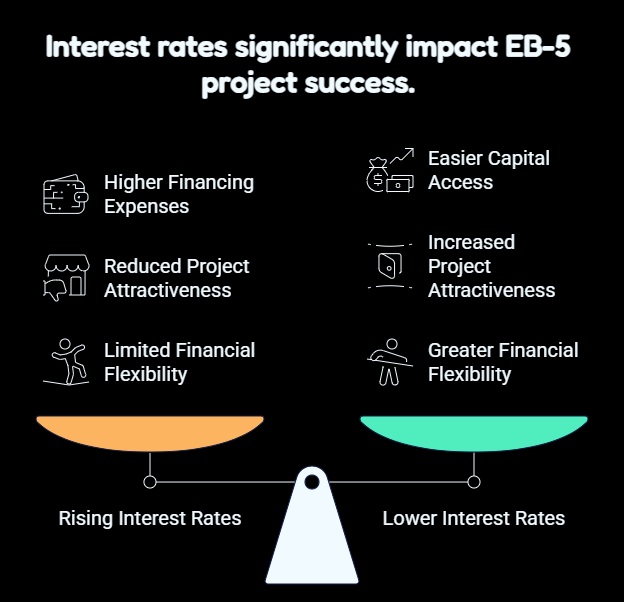
When interest rates rise, developers often face higher financing expenses. Increased borrowing costs can reduce profitability, extend development timelines, and make certain projects less attractive to consumers or businesses. For example, higher mortgage rates can reduce demand for residential properties, affecting real estate developments that depend on strong sales activity.
Lower interest rates generally create a more favorable investment environment. Businesses can access capital more easily, consumers are more likely to make significant purchases, and developers may find it easier to finance expansion plans. As a result, projects launched during periods of lower interest rates often enjoy greater financial flexibility.
Investors should carefully review how a project’s financing structure may be affected by changing interest rate conditions. Projects with strong capital reserves and conservative financial planning are often better equipped to navigate fluctuations in borrowing costs.
Inflation and Rising Development Costs
Inflation has become an increasingly important factor in investment decision-making. Rising costs for construction materials, labor, equipment, and transportation can have a substantial impact on project budgets and timelines.
A project that was financially viable at the planning stage may encounter challenges if construction expenses increase significantly during development. Unexpected cost increases can reduce profit margins, delay completion schedules, and place additional pressure on developers.
For example, a large-scale residential project may require steel, concrete, and other building materials whose prices fluctuate based on global supply and demand. If inflation causes these costs to rise sharply, the project’s overall budget may need to be adjusted.
Experienced developers often prepare for such scenarios by including contingency reserves and flexible financial planning. Investors should examine project budgets carefully to determine whether management teams have accounted for inflation-related risks and implemented strategies to address potential cost increases.
Why Regional Market Conditions Matter
While national economic trends provide valuable insight, regional market conditions often have a greater impact on project performance. A strong national economy does not guarantee success in every region, just as localized growth opportunities can exist even during broader economic challenges.
- Population growth is one of the most important regional indicators to evaluate. Areas experiencing population increases often require additional housing, healthcare services, retail establishments, and infrastructure improvements. This creates opportunities for development projects that can meet growing demand.
- Employment trends are equally important. Regions with diverse industries and expanding job markets tend to demonstrate greater economic resilience than areas heavily dependent on a single sector. Strong employment growth can support consumer spending and increase demand for various products and services.
- Infrastructure investments also play a significant role in regional development. New transportation systems, business districts, technology hubs, and public facilities can attract residents and businesses, creating favorable conditions for investment projects.
Investors who focus on local economic fundamentals rather than relying solely on national headlines are often better positioned to identify promising opportunities.
How Different Industries Respond to Market Changes
Different sectors react differently to economic conditions, making industry selection an important part of the investment process.
Real Estate Development
Real estate development remains one of the most common industries for EB-5 projects. Property values, rental demand, occupancy rates, and construction activity are all closely tied to market conditions.
Projects located in high-growth urban areas often benefit from increasing demand for residential and commercial space. However, developments in oversupplied markets may struggle to achieve projected occupancy levels. Investors should evaluate local supply-and-demand dynamics before selecting a project.
Hospitality and Tourism
The hospitality sector can perform exceptionally well during periods of economic expansion. Increased tourism, business travel, and consumer spending often support strong occupancy rates and revenue growth.
However, the hospitality industry can be more sensitive to economic downturns than some other sectors. Investors should consider factors such as location, tourism trends, and long-term demand drivers when evaluating hospitality projects.
Healthcare and Senior Living
Healthcare-related developments are often viewed as relatively stable investment opportunities. Demand for healthcare services tends to remain consistent regardless of economic conditions, supported by demographic trends and population growth.
As the U.S. population continues to age, demand for medical facilities, senior housing, and specialized healthcare services is expected to increase. This makes healthcare projects attractive for investors seeking long-term growth potential and greater resilience.
Infrastructure and Manufacturing
Infrastructure projects and manufacturing developments can benefit from government initiatives, regional development programs, and long-term economic planning. These projects often create substantial employment opportunities while supporting broader economic growth.
Because they contribute directly to job creation, infrastructure developments can be particularly appealing within the EB-5 framework.
How Market Conditions Affect Job Creation
Job creation is one of the most important requirements of the EB-5 program. Every qualifying investment must contribute to the creation of jobs for U.S. workers, making employment projections a critical component of project evaluation.
Market conditions directly influence a project’s ability to generate jobs. Strong consumer demand, business expansion, and economic growth often support increased hiring activity. In favorable markets, projects may exceed their projected employment targets.
During economic slowdowns, however, businesses may delay expansion plans or reduce hiring activity. This can affect the pace at which jobs are created and potentially impact project performance.
Investors should review economic impact reports and job creation methodologies carefully to understand how market conditions may influence employment projections. Projects with strong market fundamentals generally offer greater confidence in achieving required job creation goals.
Evaluating EB-5 Projects During Economic Uncertainty
Economic uncertainty does not eliminate investment opportunities, but it does require a more disciplined approach to due diligence.
One of the most important factors to examine is developer experience. Experienced development teams often have a proven ability to navigate challenging market conditions and adapt to changing economic circumstances. Their track record can provide valuable insight into how they may respond to future challenges.
Investors should also review a project’s capital structure. Understanding the relationship between investor funds, developer equity, and traditional financing can help assess financial stability. Projects with significant developer investment may demonstrate stronger alignment of interests and commitment to success.
Exit strategies deserve careful attention as well. Investors should understand how projects intend to generate revenue and ultimately return invested capital. Clear, realistic exit plans can provide greater confidence during periods of market volatility.
The Role of eb-5 regional centers in Market Evaluation
Many investors choose projects sponsored by eb-5 regional centers because they provide access to professionally managed investment opportunities. Regional centers typically conduct extensive market research, economic analysis, and feasibility studies before launching projects.
These organizations play an important role in project oversight, compliance management, and job creation tracking. Their expertise can help investors better understand market conditions and evaluate project viability.
However, investors should not rely solely on information provided by regional centers. Independent due diligence remains essential. Reviewing third-party reports, consulting experienced advisors, and analyzing market data can help investors make more informed decisions.
Balancing Financial Goals and Immigration Objectives
For many applicants, the primary motivation for participating in the EB-5 program is obtaining us permanent residency by investment. While immigration benefits are undoubtedly important, investors should avoid overlooking the financial aspects of their decision.
A successful EB-5 investment should balance immigration compliance with strong financial fundamentals. Projects that demonstrate solid market demand, experienced management, and realistic growth projections are often better positioned to achieve both objectives.
Focusing exclusively on immigration outcomes may lead investors to underestimate potential risks. Taking a comprehensive approach helps ensure that financial and immigration goals remain aligned throughout the investment process.
Maximizing EB5 return on investment Through Strategic Decision-Making
Although capital preservation is often a primary consideration for EB-5 investors, evaluating the potential EB5 Return on Investment remains an important part of project selection. Market conditions play a significant role in determining how effectively a project can generate revenue and maintain long-term stability.
Investors can improve their chances of success by selecting projects located in growing markets, evaluating industry trends, and assessing the financial strength of development teams. Thorough due diligence provides valuable insight into risk factors and helps identify projects with strong growth potential.
While no investment is entirely risk-free, informed decision-making and strategic planning can help investors navigate uncertainties and identify opportunities that align with their goals. A thoughtful approach can support both immigration objectives and long-term financial outcomes.
Conclusion
Market conditions have a profound influence on EB-5 investment decisions. Economic growth, inflation, interest rates, labor markets, and industry-specific trends all play a role in determining project performance and long-term viability. Investors who understand these factors are better equipped to evaluate opportunities, identify risks, and make informed decisions.
The most successful EB-5 investors recognize that immigration and investment objectives are closely connected. A project operating in a strong market environment is often better positioned to achieve job creation, maintain financial stability, and deliver sustainable results.
Before making an investment decision, take the time to conduct comprehensive due diligence, analyze market conditions, and seek guidance from experienced professionals. A strategic approach today can help pave the way for a more secure financial future and successful achievement of your U.S. immigration and investment goals.
Frequently Asked Questions
1. Why do market conditions matter for EB-5 investments?
Market conditions affect project demand, profitability, job creation, financing costs, and overall investment stability, making them a critical factor in project evaluation.
2. How do rising interest rates impact EB-5 projects?
Higher interest rates increase borrowing costs for developers, which can affect project budgets, timelines, and profitability.
3. Which industries are commonly associated with EB-5 investments?
Real estate, hospitality, healthcare, infrastructure, and manufacturing are among the most common sectors utilized for EB-5 projects.
4. Can inflation affect the success of an EB-5 project?
Yes. Rising construction and operational costs can impact project budgets and reduce financial flexibility if not properly managed.
5. Why are regional economic trends important?
Local market conditions often have a greater impact on project performance than national economic trends, making regional analysis an important part of due diligence.
6. How do market conditions influence job creation?
Economic growth and strong consumer demand typically support hiring and expansion, while economic slowdowns may reduce employment opportunities.
7. Should investors rely solely on regional center information?
No. While regional centers provide valuable analysis and oversight, independent due diligence remains essential for evaluating investment opportunities.
8. How can investors improve their chances of achieving a successful EB-5 outcome?
By conducting thorough due diligence, analyzing market conditions, reviewing project fundamentals, and seeking professional guidance before investing.
Ready to Make a Confident EB-5 Investment Decision?
Navigating changing market conditions is essential to selecting an EB-5 project that aligns with your immigration and financial goals. At EB-5 Choice, our experienced professionals help investors evaluate projects, understand market trends, and conduct thorough due diligence. Contact us today to explore carefully vetted EB-5 opportunities and take the next step toward achieving your U.S. permanent residency with confidence.