

When a US visa freeze hits, it does not affect every immigration pathway equally. For high-net-worth investors who are actively exploring investment-based residency, understanding how different immigration pathways may be affected is increasingly important.
The EB-5 Immigrant Investor Program sits in a legally distinct space from most visa categories impacted by blanket suspensions, and that distinction matters enormously for anyone planning a long-term move to the United States.
Understanding What a Visa Freeze Actually Does
A US visa freeze, in its most common form, is a presidential proclamation or executive directive that suspends the issuance of certain visa categories to nationals of specific countries. The freezes issued under Presidential Proclamations 10949 and 10998 affected nationals from over 75 countries, including Nigeria, Pakistan, Bangladesh, Ghana, and several others across Africa, Asia, and Latin America (Proclamations 10949, 10998).
What most people miss is that these freezes are not blanket bans on all immigration. They tend to target family-based immigrant visas and, in some cases, certain employment-based categories. The EB-5 program, which is a congressionally authorized investment immigration pathway, operates under a separate statutory framework. That does not make it completely immune to disruption, but it does mean EB-5 petitions may continue to be filed and adjudicated, although visa issuance and related processing may still be affected depending on applicable government policies.
This is a meaningful distinction. Investors who assume a visa freeze shuts down all US residency options are often working with incomplete information.
What Does a US Visa Freeze Mean for EB-5 Investors Specifically?
A US visa freeze creates friction for EB-5 applicants, not necessarily a full stop. The practical impact depends largely on where you are in the process and which country you are chargeable to.
If you already have an approved I-526 or I-526E petition:
- The petition itself remains valid regardless of any active proclamation or executive directive
- Your investment stays in place and is not impacted by the freeze
- The final visa stamp, however, can be delayed if your home country is listed under the relevant proclamation
- Investors in this position should explore adjustment of status inside the US as an alternative to consular processing
If you are still in the planning stage:
- A freeze on conventional immigration routes can actually make EB-5 a more urgent and strategic consideration
- Investment-based pathways backed by congressional authorization tend to hold up better when other channels narrow or become unreliable
- USCIS data from early 2026 shows a measurable uptick in I-526E filings from regions heavily impacted by the freeze
- This is not an unusual pattern. Historically, EB-5 demand rises when standard immigrant visa channels slow down
EB-5 regional centers have reported noticeably increased inquiry volumes from investors based in the Middle East, South and Southeast Asia, and sub-Saharan Africa since the freeze took effect.
That demand shift reflects a broader reality: when governments restrict conventional immigration pathways, high-net-worth families look for routes that are legally insulated and structurally independent from executive action.
The EB-5 program, for all its complexity, fits that description better than most alternatives currently available.
Need help understanding your EB-5 options? Contact EB-5 Choice today.
How EB-5 Set-Aside Categories Change the Calculation
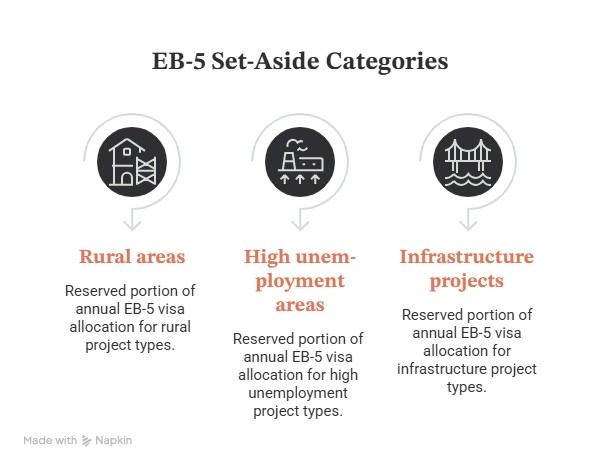
One of the most underappreciated features of the current EB-5 landscape is the set-aside visa structure introduced under the EB-5 Reform and Integrity Act of 2022. Congress reserved specific portions of the annual EB-5 visa allocation for three project types: rural areas, high unemployment areas, and infrastructure projects.
As of early 2026, all three set-aside categories remain current for all countries worldwide. That means there is no backlog, no retrogression, and no waiting period tied to the country of birth for investors who qualify through a set-aside project. This is a significant advantage, especially compared to the unreserved EB-5 category, where China and India face retrogression stretching back several years.
For an investor from a freeze-affected country who is also from a high-demand country like India or China, the set-aside route offers two benefits simultaneously. It sidesteps both the country-based retrogression and, to the extent possible, minimizes exposure to delays caused by the freezing environment.
Rural set-aside projects carry a minimum investment threshold of $800,000. That figure is the same regardless of whether the investor applies through a regional center or as a standalone investor, provided the project location qualifies. Projects in targeted employment areas, which include both rural and high unemployment designations, qualify at this lower threshold.
A Practical Comparison: EB-5 vs. Other Investor Visa Routes
For investors evaluating US permanent residency by investment against alternatives, the current environment makes the comparison sharper than usual.
| Pathway | Investment Threshold | Green Card Timeline | Affected by Freeze? |
| EB-5 Rural Set-Aside | $800,000 | 12 to 24 months (adjustment of status) | Minimal, petition continues |
| EB-5 Unreserved | $1,050,000 | Varies by country; backlog for India/China | Consular delays possible |
| E-2 Treaty Investor | No fixed minimum | Does not lead to green card | Yes, if country listed |
| L-1 Intracompany Transfer | No investment required | Employment-dependent | Yes, immigrant visa delays |
| Gold Card (proposed) | $5,000,000 | Unclear; legislation pending | Unknown |
The E-2 visa, which many HNWIs have historically used as a stepping stone, does not confer permanent residency. It also requires treaty eligibility, and many freeze-affected nationalities either lack treaty status or face increased scrutiny during consular review.
The EB-5 route, for all its complexity, offers a clear statutory path to a green card that does not depend on employment sponsorship or treaty relationships.
Challenges Investors Should Still Prepare For
Even with EB-5’s relative insulation from freeze-related disruptions, there are real challenges worth understanding before committing capital.
Consular Processing Delays
If an investor’s home country is listed under an active proclamation, the final visa issuance step can stall at the consulate. Adjustment of status, which allows the investor to get their green card from inside the United States rather than through a consulate abroad, is a practical workaround for those already in the country on a valid nonimmigrant visa.
Source of Funds Documentation
USCIS scrutiny on the lawful source of investment capital has intensified (source). Investors from certain regions may face additional documentation requests. This is not new, but the processing environment in 2026 has made thoroughness even more important than it was two or three years ago.
Project Due Diligence
Not all EB-5 regional centers carry the same risk profile. Some projects are more transparent than others in their financial disclosures, construction timelines, and job creation projections. Investors need to evaluate projects independently, not rely solely on marketing materials.
Processing Times
I-526E petition processing at USCIS has improved but is not uniform. Premium processing is not available for EB-5 petitions, so timelines depend on USCIS workload and petition completeness.
What Investors Should Do Right Now after Visa Freeze
If you are an investor actively weighing US residency options in the current freeze environment, here is a practical framework.
Check your country of birth against active proclamations
Country of birth, not current citizenship, determines EB-5 chargeability for visa number purposes. If you hold dual nationality, the unaffected passport may provide an exemption from both the freeze and any retrogression.
Assess your current US visa status
If you are already in the United States on an H-1B, F-1, L-1, or other valid nonimmigrant visa, adjustment of status is likely available once your I-526E is approved and a visa number is current. This bypasses consular processing entirely and avoids freeze-related delays at embassies.
Work with specialists, not generalists
Working with experienced EB-5 professionals, including immigration attorneys and consultants, is especially important in a volatile regulatory environment. Set-aside categories, adjustment of status eligibility, CSPA age-out rules for dependent children, and source of funds documentation are not areas where a general immigration attorney will necessarily have deep current knowledge.
Verify the TEA designation on any set-aside project you consider
USCIS has issued RFEs on TEA qualifications, and a designation that looked solid at filing can face scrutiny if the underlying data changes. Make sure it is properly documented and defensible before committing capital.
Think about EB-5 return on investment in realistic terms
EB-5 capital is typically at risk for several years. EB-5 return on investment, when they exist, are modest compared to conventional private equity or real estate. For many investors, the primary objective is obtaining lawful permanent residence, while financial return is generally considered secondary. Investors who treat it as a residency strategy and evaluate projects on capital preservation terms tend to have a far clearer-headed experience.
Conclusion
A US visa freeze is a serious policy development, and its effects on global mobility are real. But for investors who understand how EB-5 works at a structural level, a freeze is more of a complicating factor than a disqualifying one. The program’s congressional foundation, the set-aside visa structure, and the adjustment of status option collectively create a pathway that remains navigable even when standard immigrant visa channels are disrupted.
The investors who tend to navigate this environment best are the ones who start the process with accurate information, work with specialists who understand the current regulatory landscape, and go into the investment with realistic expectations about timelines and returns. The freeze has made the EB-5 conversation more urgent for a lot of families who previously assumed other routes would stay open. For those families, the program’s relative stability is one of its most significant advantages in an evolving immigration environment.
Have questions about your EB-5 journey? Inquire with us today.
Frequent Answer Question
Does a US visa freeze cancel or void an approved EB-5 petition?
No. An approved I-526 or I-526E petition remains valid regardless of any executive proclamation affecting visa issuance. The freeze can delay when a visa is physically issued at a consulate, but it does not invalidate the petition or the investment. Investors already in the pipeline retain their priority dates and petition approvals.
Which EB-5 category is least affected by the current freeze environment?
The rural set-aside category is currently the most insulated option. It is current for all countries worldwide, meaning there is no retrogression-related wait on top of any freeze-related consular delays. Investors who qualify through a rural project and are eligible for adjustment of status inside the US can largely sidestep the freeze’s practical impact.
Can dual nationals from freeze-affected countries still apply for EB-5?
Yes, in most cases. Dual nationals applying with a passport from a country not subject to the active suspension are generally exempt from the freeze. For EB-5 chargeability purposes, if the investor holds nationality in a country that is current and not subject to proclamation restrictions, they can process under that nationality, subject to USCIS and State Department rules.
How long does the EB-5 process typically take from filing to green card?
Timelines vary significantly. For investors adjusting status inside the US through a set-aside rural project, the timeline from I-526E filing to green card can be as short as 12 to 24 months in current conditions. Consular processing from outside the US takes longer and is more exposed to freeze-related delays. Unreserved category investors from China and India face substantially longer waits due to retrogression.
What is the minimum investment amount for EB-5 in 2026?
The minimum investment is $800,000 for projects located in targeted employment areas, which includes rural and high unemployment designations. The standard investment threshold outside of TEA projects is $1,050,000. Most active EB-5 projects marketed through regional centers are structured to qualify at the $800,000 TEA level.