

EB-5 source of funds documentation is one of the most important parts of an EB-5 petition. Most petitions are not denied because the investment money was earned illegally, but because investors cannot prove it was earned legally in the way USCIS requires, due to their EB-5 source of funds mistakes. Even a legitimate $800,000 or $1,050,000 investment can be denied if the paper trail contains gaps, inconsistencies, or unexplained transfers. Since adjudicators review this documentation line by line, it is a common reason USCIS issues Requests for Evidence (RFEs) and, in some cases, petition denials.
This guide walks through the mistakes that most often derail an otherwise strong petition, along with what has changed in how USCIS reviews these cases in 2026.
Why Source of Funds Gets So Much Scrutiny
Every EB-5 investor has to satisfy two separate requirements, and it helps to keep them mentally distinct.
The first is source of funds, which proves the investment money was obtained lawfully through employment income, business profits, asset sales, inheritance, gifts, or loans. The second is the path of funds, which shows exactly how that money moved to the new commercial enterprise. Both require clear and complete USCIS documentation so adjudicators can verify every step.
Investors often focus only on the source of funds and overlook the path of funds. However, USCIS treats both as equally important, and many recent denials result from gaps in the transfer history rather than concerns about how the money was earned.
When preparing your petition, assume USCIS will ask, “What happened next?” at every stage, and make sure your evidence clearly answers that question. This is exactly the kind of scrutiny experienced EB-5 visa consultants help investors prepare for long before filing.
Common Mistakes in EB-5 Investment Source of Funds Documentation
1. Co-Mingling Investment Money With Everything Else
Depositing your EB-5 capital into an account that also receives salary, business income, gifts, or other transfers makes it difficult to trace your investment. USCIS will not assume the “clean” portion of a mixed account funded your petition and may require documentation for every deposit.
The best approach is to open a dedicated account for your EB-5 funds well before filing and transfer only money you can fully document. Creating a clean paper trail from the start is much easier than reconstructing one later.
2. Leaving Gaps in the Transaction Timeline
Missing bank statements, unexplained transfers, or incomplete records can quickly turn a straightforward petition into an RFE—or even a denial. USCIS expects every movement of funds to be fully documented.
Recent adjudication trends place greater emphasis on the initial filing, making complete documentation more important than ever. Build the full transaction history before filing rather than waiting for USCIS to request additional evidence.
3. Under-Documenting Gifts and Loans
Gifts and loans are acceptable EB-5 funding sources, but they require thorough documentation. USCIS expects proof that the donor or lender also obtained the funds lawfully, not just evidence that you received the money.
Provide tax records, income history, and bank statements for the donor or lender, along with a legally executed loan agreement when applicable.
If part of your funding plan involves borrowing against personal assets, review our guide on secured loan vs unsecured loan options for EB-5 to understand how each structure is documented and what USCIS expects to see.
4. Skipping Tax Compliance Evidence
Money that was earned legitimately but never properly taxed in your home country does not meet the “lawfully obtained” standard, even if nobody disputes where it came from. This trips up investors more often than you would expect, particularly when funds come from business income or the sale of an asset that was never formally declared.
Bring several years of personal and corporate tax filings, and if a jurisdiction genuinely had no tax obligation for that income, bring official documentation proving that too. Silence on tax history reads as a red flag, not as a non-issue.(source)
5. Using Investment Structures With Guaranteed Returns
EB-5 capital has to be genuinely at risk. A subscription agreement with a buy-back clause, a guaranteed redemption date, or any side agreement promising your principal back regardless of how the EB-5 project performs undermines the entire basis of the investment. This is one of the few mistakes that has nothing to do with your personal documentation and everything to do with how the project itself is structured, which is exactly why picking the right project matters as much as building a clean paper trail.
If you are still evaluating options, our guide on how to choose the right EB-5 project for your investment is a good place to start before you sign anything.
6. Treating “Savings” or “Gift” as a Sufficient Explanation
A vague label is not a source. “Savings” without a breakdown of how that money accumulated, or “gift” without a gift letter, donor documentation, and applicable tax filings, will not survive review. Adjudicators want a narrative backed by primary documents at every step, not a summary.
7. Overlooking Cryptocurrency Conversions
This is one of the fastest-growing problem areas. If any part of your investment passed through cryptocurrency, even years ago, USCIS expects documentation of the original coin purchase, including the exchange used, the fiat currency that funded it, and proof that those funds were lawfully obtained. A record showing only the Bitcoin-to-USD conversion is not enough if the original purchase is undocumented. Crypto-related source of funds issues are increasingly leading to denials, so build this documentation early.
8. Ignoring Country-Specific Remittance Rules
For investors transferring funds internationally, especially from India and China, home-country remittance rules add another layer of documentation. Indian investors must comply with the Reserve Bank of India’s Liberalized Remittance Scheme, while Chinese investors face separate foreign exchange restrictions. As Indian EB-5 filings continue to grow, documentation gaps caused by funds moving through multiple relatives’ accounts have become a common issue flagged by USCIS.
Have questions about your funding documents? Connect with EB-5 Choice
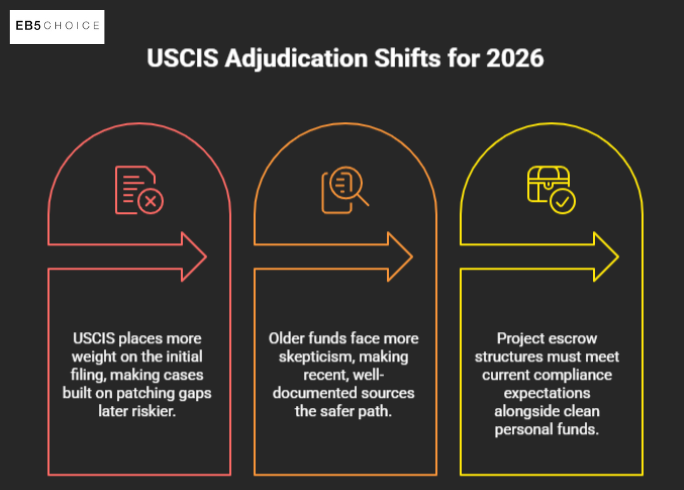
What Has Changed in USCIS Adjudications for 2026
A few shifts are worth calling out on their own, because they affect how you should approach preparation, not just what documents you gather.
Denials Without a Prior RFE Are Increasing
Denials without a prior RFE are becoming more common. USCIS has been placing more weight on the initial filing itself, which means a case built with the assumption that gaps can be patched later is a riskier bet than it used to be.
Older Financial Records Face Greater Scrutiny
Older funds face more skepticism. Money that changed hands a decade ago is harder to document to current standards. Where you have a choice between an older source and a more recent, well-documented one, the recent one is usually the safer path.
Escrow Arrangements Are Under Closer Review
Escrow structure has become its own scrutiny point. It is not enough for your personal funds to be clean if the project’s escrow arrangement does not meet current compliance expectations, which is one more reason project selection and source of funds preparation should not be treated as separate tracks.
Concerns here overlap with the broader diligence process, which we cover in more depth in Understanding EB-5 Fraud and the Role of Due Diligence.
How to Build a Source of Funds File That Holds Up
For investors pursuing an US Green Card by Investment through the EB-5 program, a few habits separate those who file cleanly from those who end up managing an RFE mid-process:
- Start documentation 12 to 18 months before you plan to file, not after your attorney asks for it.
- Keep EB-5 capital in a segregated account from the earliest possible point.
- Get certified translations and, where applicable, apostilles on foreign documents well ahead of filing.
- Treat every dollar’s origin as something you will need to defend twice: once on paper, and once if an adjudicator has follow-up questions.
- Coordinate source of funds preparation with your broader EB-5 immigration process timeline, including USCIS filing fees, since delays in one area often push back the other. Our overview of USCIS fees and premium processing is a useful companion read if you are mapping out your filing schedule.
None of this requires perfection on the first draft. It requires starting early enough that gaps surface while you still have time to close them, rather than after they show up in an RFE.
Conclusion
The source of funds for EB-5 requirements is not designed to trip up honest investors, but it is designed to catch sloppy documentation, and in 2026’s adjudication environment, sloppy documentation carries more risk than it used to. The investors who move through this process smoothly are almost never the ones with the most complicated financial histories. They are the ones who started organizing their paper trail early, kept their funds separate, and treated every transfer as something they would eventually need to explain.
If you are preparing to file and want a second set of eyes on your funding structure before you submit, EB-5 Choice works with investors through exactly this stage of the process. Reach out to our team to review your source of funds documentation and make sure your petition starts on solid ground.
Need help reviewing your EB-5 source of funds? Contact EB-5 Choice before you file your petition.
Frequently Asked Questions
What counts as an acceptable source of funds for EB-5?
Employment income, business earnings, proceeds from a property or asset sale, inheritance, gifts, and loans secured by personal assets are all recognized sources, provided each one is documented with tax records, bank statements, and a clear ownership history.
How many years of financial records does USCIS want to see?
Most attorneys recommend at least seven years of organized records, though more recent documentation is generally viewed more favorably than older records that are harder to verify.
Does a gift need to come from a family member?
No, but regardless of the relationship, USCIS expects documentation of the donor’s own lawful source of funds, a formal gift letter, and any applicable gift tax filings.
What happens if USCIS finds a gap in my source of funds documentation?
Historically this triggered a Request for Evidence, but recent adjudication trends show USCIS increasingly willing to deny petitions on gaps in the initial filing, which is why building a complete file before submission matters more than it used to.
Should I use a single source of funds or combine multiple sources?
Either approach is acceptable, but combining sources means each one has to be independently documented and traced, so investors using multiple sources should budget extra time for preparation.