


For investors and families following the New US Immigration Law developments in 2026, the important question is not simply what is changing, but which immigration pathway offers a clear route toward permanent residence.
EB-5 remains one of the most structured investment-based options because it connects a qualifying investment with U.S. job creation and a potential path to permanent residency.
Unlike some immigration categories that depend heavily on an employer or family sponsor, EB-5 gives qualified investors a separate route to pursue a U.S. green card.
What Does the New US Immigration Law Mean for EB-5 Investors?
U.S. immigration policies can change through laws, executive actions, agency rules, and visa updates, but not every change applies to EB-5. The program requires a qualifying investment and the creation of at least 10 full-time jobs, with a minimum investment generally set at $800,000 for qualifying targeted employment area or infrastructure investments and $1.05 million for other investments. (Source)
Investors must also prove that their funds were obtained and transferred lawfully. The New US Immigration Laws 2026 may affect different visa categories differently, so investors should distinguish between proposed policies, executive actions, agency procedures, and enacted laws before making immigration or investment decisions.
Why Does the New US Immigration Law Make EB-5 Attractive?
EB-5 attracts investors because it connects investment and job creation with a pathway to U.S. permanent residence. Investors should also consider potential EB-5 returns alongside the immigration benefits and financial risks of the program.
Less Dependence on an Employer
Unlike some employment-based options, EB-5 does not require investors to maintain a specific employer relationship. This can provide greater flexibility for entrepreneurs, business owners, and families planning their U.S. future.
A Family-Oriented Immigration Option
A qualifying EB-5 investor may generally include a spouse and unmarried children under 21 as derivative beneficiaries. This makes EB-5 an option for families seeking long-term U.S. residency.
A Defined Route Toward Permanent Residence
EB-5 involves qualifying investment, job creation, and other immigration requirements. Investors should evaluate the project’s risks, potential EB-5 investment returns, and immigration benefits before making an investment decision.
How Does EB-5 Compare With Other U.S. Immigration Options?
Choosing an immigration pathway requires more than looking at which visa is currently receiving the most attention. The right option depends on an applicant’s finances, qualifications, family circumstances, employment situation, and long-term objectives.
EB-5 vs. Employment-Based Immigration
An employment-based route may be suitable for a professional whose primary goal is to work in the United States through a qualifying employer. EB-5 may be more relevant for an investor who wants an investment-based immigration strategy and does not want the entire plan to depend on employment sponsorship.
EB-5 vs. Family-Based Immigration
Family-based immigration depends on a qualifying family relationship and the applicable petition and visa requirements. EB-5 instead focuses on investment, job creation, and other program requirements.
Quick Comparison
| Factor | EB-5 Visa | Employment-Based Route | Family-Based Route |
| Primary basis | Investment and job creation | Employment and qualifications | Qualifying family relationship |
| Investment required | Yes | Usually no | No |
| Employer dependency | Generally no | Often yes | No |
| Job creation | At least 10 qualifying jobs | Depends on category | No |
| Family eligibility | Spouse and qualifying children may be included | Depends on category | Depends on relationship |
| Green card potential | Yes, subject to requirements | Yes, depending on category | Yes, depending on category |
For investors exploring U.S. immigration by investment, this comparison highlights why EB-5 continues to attract families seeking a pathway to permanent residence.
What Are the Latest U.S. Immigration Changes Investors Should Watch?
The Latest US Immigration Law Changes should be monitored carefully, but investors should focus on changes that can actually affect their application, investment, or visa availability.
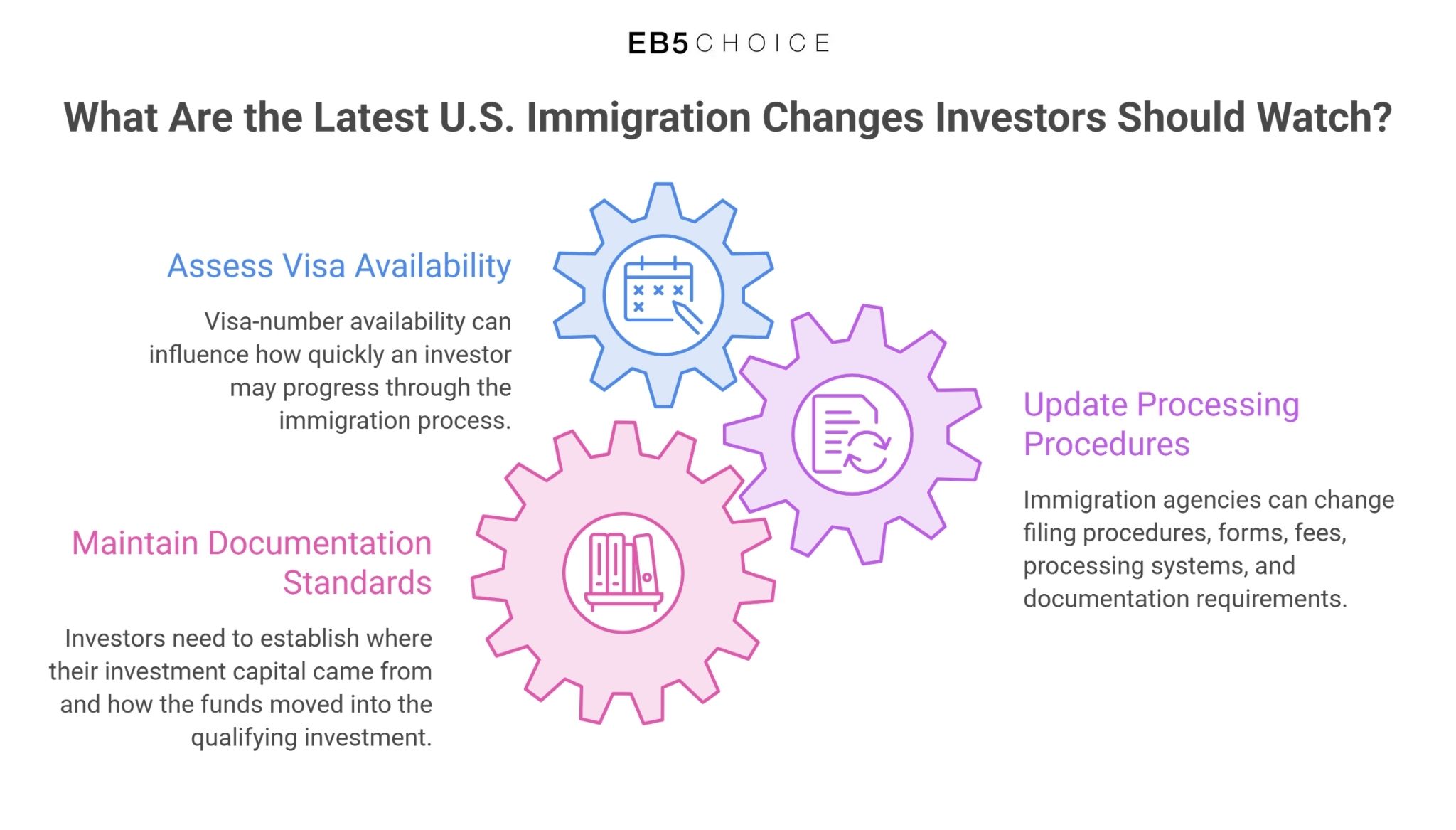
Visa Availability
Visa availability can influence how quickly an investor may progress through the immigration process. Even when an applicant meets the underlying eligibility requirements, visa-number availability can become an important practical consideration.
Processing Procedures
Immigration agencies can change filing procedures, forms, fees, processing systems, and documentation requirements. These procedural changes may not alter the fundamental EB-5 program but can affect how an application must be prepared and submitted.
Documentation Standards
Strong documentation is especially important in EB-5 cases. Investors need to establish where their investment capital came from and how the funds moved into the qualifying investment.
For example, depending on the circumstances, supporting records may include tax documents, bank statements, business records, property-sale documents, loan documentation, inheritance records, or other financial evidence.
How Can Investors Understand the EB-5 Process better?
Understanding the program requires looking at both immigration requirements and the practical realities of making an investment.
Start With Eligibility
Before reviewing specific projects, investors should consider whether their financial position, family circumstances, investment objectives, and immigration goals align with the program.
Evaluate the Investment Separately
Immigration eligibility and investment performance are separate considerations. A project may potentially satisfy immigration requirements while still carrying financial risks.
Investors should review the project’s business model, financial structure, job creation plan, sponsor background, use of funds, repayment strategy, and other relevant factors.
Prepare Source-of-Funds Evidence
Source-of-funds documentation can become one of the more detailed parts of an EB-5 case. Depending on how the capital was accumulated, investors may need records involving employment income, business earnings, property transactions, loans, gifts, inheritance, or other legitimate sources.
EB-5 Choice can be a useful starting point for new investors seeking to understand the different stages involved in evaluating an EB-5 opportunity and preparing for the immigration process.
Contact EB-5 Choice for structured EB-5 Guidance
Monitor Immigration Updates
Immigration requirements can evolve through legislation, agency guidance, and procedural changes. Investors should verify significant developments before making decisions that involve substantial financial commitments.
Can EB-5 Lead From a Green Card to U.S. Citizenship?
Yes, EB-5 can be part of a longer journey that eventually leads to U.S. citizenship, but the investment itself does not provide immediate citizenship.
From Conditional Residence to Permanent Residence
An approved EB-5 investor may initially receive conditional permanent resident status. The investor must then satisfy the applicable requirements to remove the conditions and obtain permanent resident status.
The process requires evidence that the investment and job creation requirements were fulfilled according to the program rules.
Learn the full difference in our detailed guide on EB-5 Conditional Green Card vs. Permanent Green Card
From Permanent Residence to Citizenship
Citizenship is a separate legal step. A permanent resident must satisfy the applicable naturalization requirements, which can include requirements concerning continuous residence, physical presence, good moral character, and other eligibility factors.
Therefore, an EB-5 visa to citizenship should be understood as a multi-stage immigration journey rather than a direct conversion from an investment visa into citizenship.
What Practical Steps Should an EB-5 Investor Take?
The US Immigration Law Changes in 2026 makes it important for investors to approach the process systematically rather than relying on social media headlines or informal advice.
Step 1: Assess Personal Eligibility
Review your financial position, family circumstances, investment objectives, and immigration goals before selecting a pathway.
Step 2: Verify the Investment Requirement
Determine whether the proposed investment qualifies under the applicable EB-5 rules and whether the required investment amount is appropriate for the project.
Step 3: Conduct Independent Due Diligence
Do not evaluate a project only because it is marketed as an EB-5 opportunity. Review its financial structure, business fundamentals, job creation strategy, and potential risks.
Use our EB-5 Due Diligence Checklist before committing to any project.
Step 4: Organize Financial Records
Create a complete record showing how the investment funds were earned, transferred, and invested. Clear documentation can make the immigration process more manageable.
Step 5: Seek Appropriate Professional Guidance
Investors seeking professional immigration guidance should distinguish between general immigration assistance and legal representation. Immigration attorneys can provide legal advice and represent clients in matters requiring legal expertise. Financial professionals can separately help investors assess investment-related risks.
Final Thoughts
For investors reviewing the Latest US Immigration Rules 2026, the most important approach is to separate general immigration headlines from the specific rules that apply to EB-5. Immigration policy can change, but not every development affects every visa category in the same way.
EB-5 remains distinctive because it provides an investment-based route toward permanent residence, with clear requirements involving investment, job creation, and documentation. The program is not risk-free and does not guarantee approval. Investors still need to evaluate projects carefully, document their source of funds, understand visa availability, and obtain appropriate professional guidance.
For families with the financial resources and genuine intention to establish a future in the United States, EB-5 remains a pathway worth serious consideration. EB-5 Choice can help investors explore the program and understand the key considerations involved, while qualified legal and financial professionals can provide specialized advice for individual circumstances.
Frequently Asked Questions About EB-5
Is EB-5 still available in 2026?
Yes. EB-5 remains an established U.S. immigrant investor program. However, applicants must meet the applicable investment, job creation, source-of-funds, and immigration requirements. Visa availability and processing conditions can also change, so investors should review the current situation before making significant financial or immigration decisions.
How much does an EB-5 investment require?
The minimum qualifying investment is generally $800,000 for an investment meeting the targeted employment area or qualifying infrastructure requirements. The standard minimum is generally $1.05 million for other qualifying investments. Meeting the investment amount alone does not guarantee eligibility or approval.
Does EB-5 guarantee a U.S. green card?
No. EB-5 is not a guaranteed green card program. The investor must satisfy all applicable requirements, including qualifying investment, lawful source and path of funds, job creation, and other immigration conditions. Proper project evaluation and complete documentation are therefore essential parts of the process.
Can EB-5 include family members?
Generally, an eligible principal investor may include a spouse and unmarried children under 21 as derivative beneficiaries, provided they meet the applicable requirements. This family component makes EB-5 relevant to investors who are planning a long-term move to the United States with their immediate family.
Is EB-5 better than an employment-based visa?
Neither pathway is automatically better for everyone. Employment-based immigration may suit qualified professionals whose primary objective is working through a U.S. employer. EB-5 may be more suitable for investors seeking an investment-based route toward permanent residence and greater independence from employment sponsorship.