


An EB-5 Due Diligence Checklist is an important tool for investors seeking U.S. permanent residency through the EB-5 Immigrant Investor Program. Beyond selecting a project, investors should carefully review the developer, financial structure, job creation strategy, and immigration requirements to make informed decisions and minimize potential risks.
Choosing the right EB-5 investment requires more than selecting a promising project. Each investment opportunity carries unique financial, operational, and immigration considerations. By carefully evaluating the project, developer, financial structure, and compliance requirements, investors can make more informed decisions that align with their U.S. immigration objectives and long-term financial goals.
Understanding Due Diligence in the EB-5 Program
Due diligence is the process of thoroughly investigating an investment opportunity before committing funds. In the EB-5 industry, it involves examining the project’s financial viability, job creation potential, legal compliance, management team, and exit strategy.
Thousands of investors have successfully obtained U.S. permanent residency through the EB-5 program. However, investment outcomes vary depending on factors such as project selection, financial performance, and regulatory compliance. Conducting thorough due diligence before investing can help investors better understand these risks and make informed decisions.
A well-executed due diligence process can help investors:
- Reduce financial risk
- Improve immigration success rates
- Evaluate project stability
- Understand repayment strategies
- Identify potential red flags early
- Make informed investment decisions
Why Due Diligence Matters More Than Ever
The EB-5 marketplace has evolved significantly over the last decade. Investors now have access to a wider range of projects, including:
- Real estate developments
- Hospitality projects
- Mixed-use commercial properties
- Infrastructure initiatives
- Manufacturing facilities
- Healthcare developments
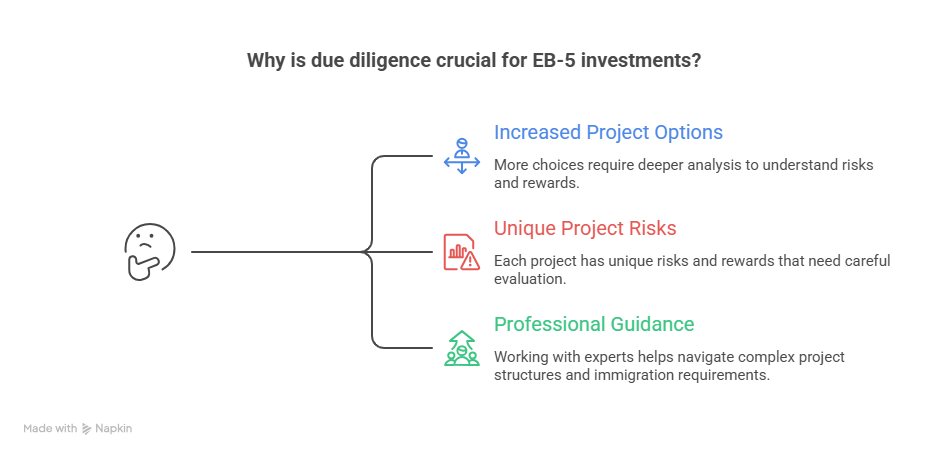
While more options create opportunities, they also require deeper analysis. Every project presents unique risks and rewards, making due diligence a critical step in the investment journey.
Many investors work with experienced EB-5 visa consultants, immigration attorneys, and other EB-5 professionals to better understand project structures, offering documents, and immigration requirements before making an investment decision.
The Ultimate EB-5 Due Diligence Checklist
1. Verify Regional Center Credentials
One of the first steps in EB-5 due diligence is evaluating the regional center associated with the project. Investors should confirm whether the regional center is properly designated, how long it has been operating, and its overall track record. It is also important to review how many investors have successfully completed the EB-5 process through the center and whether previous projects have met job creation requirements. A regional center with a strong history of successful project execution can provide greater confidence and reduce potential risks for investors.
2. Evaluate the Project Developer
The success of an EB-5 project often depends on the experience and reputation of the developer. Investors should research the developer’s past projects, financial strength, industry expertise, and project management capabilities. Reviewing any litigation history can also provide valuable insights into potential concerns. For example, a developer with a proven track record of completing multiple hospitality developments may be better equipped to manage a new hotel project than a company with limited experience in the sector.
3. Review the Business Plan Thoroughly
The business plan serves as the foundation of an EB-5 project and should be reviewed carefully. A strong business plan clearly outlines the project’s objectives, market demand, revenue projections, job creation methodology, construction timelines, and potential risks. Investors should focus on whether the assumptions and projections are realistic and supported by market data rather than relying on overly optimistic forecasts that may not be achievable.
4. Analyze Job Creation Potential
Job creation is a fundamental requirement of the EB-5 program, making it a critical area of due diligence. Investors should understand how jobs will be calculated, which economic model is being used, whether there is an adequate job cushion, and how potential delays could affect job creation targets.
Projects with a larger projected job cushion may provide additional protection if actual job creation falls below expectations due to construction delays or other unforeseen circumstances.
5. Understand Capital Stack Structure
Investors should carefully examine the project’s capital stack to understand how it is financed. This includes reviewing the amount of developer equity, senior loans, mezzanine financing, and the proportion of EB-5 investment capital involved. Projects in which developers contribute significant equity often demonstrate a stronger commitment to the project’s success and better alignment with investor interests, as the developers have substantial capital at risk alongside investors.
6. Examine Offering Documents
Offering documents provide essential information about the investment terms, structure, and risks. Investors should thoroughly review documents such as the Private Placement Memorandum (PPM), Subscription Agreement, Limited Partnership Agreement, and Operating Agreement.
These materials should clearly explain investor rights, applicable fees, risk disclosures, exit strategies, and how capital will be deployed throughout the project.
Because these documents contain important legal and financial information, investors should consider reviewing them with experienced legal counsel before making an investment decision.
Financial Due Diligence Essentials
Review Revenue Assumptions
Investors should assess whether projected revenues align with market realities.
Questions to consider:
- Are occupancy projections reasonable?
- Is local demand sufficient?
- What are competitor performance levels?
- Have independent market studies been conducted?
Overly aggressive revenue projections can increase project risk.
Assess Debt Obligations
Debt plays a major role in project performance.
Higher debt levels can increase pressure on project cash flow and may create refinancing or repayment challenges during periods of economic uncertainty.
Review:
- Loan repayment schedules
- Interest rates
- Refinancing risks
- Senior lender requirements
High debt levels can create additional pressure on project cash flow.
Evaluate Project Exit Strategy
One of the most common investor concerns involves capital recovery.
A strong exit strategy should explain:
- How investor funds will be repaid
- Expected repayment timeline
- Sources of repayment
- Potential market conditions affecting repayment
Understanding EB5 Investment Returns requires evaluating both immigration outcomes and financial recovery expectations. While the primary objective for many investors is residency, understanding capital preservation remains equally important.
Immigration Due Diligence Checklist
Confirm Source of Funds Eligibility
Investors must demonstrate that investment capital was obtained lawfully.
Common sources include:
- Business income
- Employment earnings
- Property sales
- Investments
- Gifts
- Inheritance
Proper documentation can prevent delays during application review.
Review USCIS Compliance
Every project should be structured to comply with current immigration regulations.
Investors should verify that the project is structured in accordance with applicable USCIS requirements and current immigration regulations.
Investors should confirm:
- Job creation methodology meets requirements
- Capital is placed at risk
- Investment amount meets eligibility standards
- Project documentation is current
Changes in regulations can affect project structures, making professional guidance valuable.
For more insights on how proposed immigration policy changes could affect investors, read our guide on How the SAVE America Act Affects EB-5 Immigrant Investors.
Assess Processing Timelines
Processing times can vary significantly.
Investors should understand:
- Filing timelines
- Project development schedules
- Construction milestones
- Expected immigration milestones
Setting realistic expectations helps reduce uncertainty throughout the process.
Market Due Diligence Factors
Analyze Local Economic Conditions
A project’s success is often tied to local economic performance.
Research:
- Population growth
- Employment trends
- Business activity
- Infrastructure development
- Tourism demand
For example, a hotel project located in a rapidly growing metropolitan area may have stronger growth potential than one in a stagnant market.
Understand Industry Trends
Industry-specific trends can significantly impact project performance.
Current sectors attracting attention include:
- Logistics facilities
- Multifamily housing
- Healthcare infrastructure
- Industrial developments
- Mixed-use projects
Investors should evaluate whether the project aligns with long-term market demand.
Red Flags Every Investor Should Watch For
Unrealistic Financial Projections
Be cautious if:
- Revenue estimates seem unusually high
- Costs appear underestimated
- Market assumptions lack supporting data
Limited Developer Experience
A lack of relevant experience can increase execution risk.
Developers with limited experience managing projects of similar size or complexity may face additional execution challenges. Investors should review the developer’s completed projects, financial stability, and overall track record before making an investment decision.
Weak Job Creation Buffer
Projects with minimal job cushions may face greater immigration-related risk if unexpected challenges arise.
Projects with a limited job cushion may face increased immigration risk if construction delays, budget overruns, or lower-than-expected economic activity reduce the number of qualifying jobs ultimately created.
Lack of Transparency
Avoid projects that:
- Withhold important information
- Provide incomplete documentation
- Resist independent review
Transparency is often a strong indicator of project quality.
Unclear Exit Strategy
If repayment plans are vague or unsupported, investors should proceed carefully.
A clearly defined exit strategy should explain how investor capital is expected to be repaid, the anticipated repayment timeline, and the potential factors that could affect repayment. If these details are unclear, investors should seek clarification before proceeding.
Building a Professional Due Diligence Team
Successful investors rarely conduct due diligence alone.
A strong advisory team may include:
- Immigration attorneys
- Securities attorneys
- Financial advisors
- Tax professionals
- Project analysts
These professionals can help identify risks and evaluate opportunities from multiple perspectives.
Investors pursuing US Permanent Residency by Investment often achieve better outcomes when supported by experienced professionals who understand both immigration and investment considerations.
Real-World Example: How Due Diligence Prevents Risk
Consider two hypothetical investors evaluating separate EB-5 projects.
Investor A conducts minimal research and selects a project based solely on marketing materials. The project later experiences delays, reducing job creation and extending repayment timelines.
Investor B performs extensive due diligence, reviews financial documents, evaluates the developer’s track record, and consults industry professionals. The selected project remains on schedule, generates sufficient jobs, and successfully supports the immigration process.
While no investment is risk-free, conducting thorough due diligence can help investors better evaluate potential risks and make more informed investment decisions.
Best Practices for EB-5 Investors
Before making an investment, remember these key principles:
- Never rush into a project
- Review all offering documents carefully
- Verify developer experience
- Evaluate job creation assumptions
- Understand repayment mechanisms
- Seek independent professional advice
- Ask detailed questions
- Compare multiple opportunities
- Monitor project progress regularly
A disciplined approach can help investors balance immigration goals with financial considerations. Following a structured due diligence process can help investors make informed decisions while balancing their immigration objectives with financial considerations.
Conclusion
The EB-5 program offers a valuable pathway to U.S. residency, but investment decisions should never be made without comprehensive due diligence. Evaluating project fundamentals, financial structures, job creation potential, developer experience, and compliance requirements can help investors minimize risk and maximize confidence.
A successful EB-5 investment is built on informed decision-making rather than assumptions. By following a structured due diligence checklist and working with experienced professionals, investors can position themselves for a smoother immigration journey and stronger investment outcomes.
If you’re exploring EB-5 opportunities, take the time to conduct thorough research, ask the right questions, and partner with trusted advisors who can guide you through every stage of the process.
Frequently Asked Questions (FAQs)
1. What is EB-5 due diligence?
EB-5 due diligence is the process of evaluating an investment project, developer, financial structure, and immigration compliance before investing to reduce risk and improve decision-making.
2. Why is due diligence important in EB-5 investments?
Due diligence helps investors identify risks, assess project viability, evaluate job creation potential, and understand capital recovery strategies before making an investment.
3. What documents should investors review before investing?
Key documents include the Private Placement Memorandum (PPM), Subscription Agreement, Operating Agreement, business plan, financial projections, and project reports.
4. How can investors evaluate an EB-5 project’s job creation potential?
Investors should review economic impact reports, job creation models, construction timelines, and available job cushions to ensure compliance with program requirements.
5. Are EB-5 investments guaranteed?
No. EB-5 investments must remain at risk, meaning there are no guarantees regarding financial returns or immigration outcomes.
6. How can investors improve their chances of selecting the right project?
Investors should conduct thorough due diligence, compare multiple projects, seek independent legal and financial advice, and work with experienced industry professionals.
7. What are the biggest red flags in an EB-5 project?
Common warning signs include unrealistic financial projections, inexperienced developers, weak job creation margins, poor transparency, and unclear exit strategies.
8. How long should investors spend conducting due diligence?
The timeline varies, but investors should take sufficient time to review documentation, consult experts, and fully understand project risks before committing capital.