


Thousands of applicants worldwide are seeing their path to permanent residency reshaped by shifting federal guidelines. Timelines are longer, documentation requirements are stricter, and processing has become harder to predict than it has been in years. Green Card Processing Delays are pushing cases further back than many applicants expected, and for those already deep in the queue, the situation may get worse before it gets better. Understanding what changed and why is now more important than ever, especially for investor visa applicants who need to plan carefully before moving forward.
This blog explores these policy changes in depth, examining what’s causing the delays, how they’re affecting different green card categories, and what applicants can do to protect their timelines going forward.
What Is Actually Happening With Green Card Processing Right Now?
The U.S. immigration system has never been simple, but 2024 and 2025 brought administrative changes that added friction at nearly every stage. USCIS reported a backlog of over 1.8 million pending employment-based and family-based cases as of late 2024, driven by staffing adjustments, new security screening layers, and shifting federal policy priorities.
For many applicants in employment-based preference categories, this has meant an additional 12 to 36 months on top of already long wait times. EB-2 and EB-3 applicants from high-demand countries like India and China are waiting a decade or longer for their priority dates to become current. For families, careers, and businesses, these delays carry a very real cost. (Source)
Related New Immigration Law: What Changed and When
New U.S. Immigration Policies Cause Delays across multiple visa categories, and understanding the specific legal changes helps clarify why backlogs have grown so fast.
Executive-Level Policy Shifts
Beginning in early 2025, executive actions tightened vetting requirements across visa categories, directing agencies to conduct more extensive background checks and apply additional scrutiny to petitions. The operational effect was slower adjudications across the board.
Regulatory Changes to Adjudication Standards
USCIS revised its internal policy manual to raise the evidentiary bar for several petition types. RFEs increased significantly and approval rates dropped, with more cases returned for supplemental documentation than in previous years.
Congressional Inaction and Visa Bulletin Volatility
Without legislative reform, per-country visa caps remain unchanged despite growing global demand. Priority dates move slowly or retrogress entirely, leaving applicants in longer holding patterns than anticipated.
For more information, read our blog on How EB-5 Still Gives You the Most Reliable Path to a Green Card.
What Are the Reasons Behind Green Card Processing Delays?
Staffing Constraints at USCIS
USCIS is fee-funded, so staffing levels follow application volume. Hiring reductions during the pandemic left the agency struggling to keep pace as volumes rebounded. Complex cases require experienced adjudicators, and that takes time to rebuild.
The Per-Country Cap Problem
U.S. law caps green cards at 7 percent per country annually. An applicant from Australia might wait two to three years, while an applicant from India in the same category could wait 50 years or more under current projections. This structural imbalance drives the bulk of the backlog.
Increased Security Vetting
New U.S. Immigration Policies Lead to Delays because interagency security consultations now take longer. Cases flagged for FBI or DOS review can sit in administrative processing for months with little communication to the applicant.
Higher RFE Rates
When USCIS issues an RFE, the case effectively pauses. After the applicant responds, it re-enters the queue. New U.S. Immigration Measures Create Delays most visibly here, with RFE rates rising across nearly every petition category.
Consular Processing Backlogs
Many embassies are still clearing pandemic-era appointment backlogs. In some countries, immigrant visa interview wait times now stretch 18 months or longer.
For more information, read our blog on Key Benefits for Green Card Holders in the U.S.A after Residency.
How Do New U.S. Immigration Policies Delay Investor-Based Green Cards Specifically?
The EB-5 investor visa category faces its own set of delays. The program allows foreign nationals to obtain permanent residency through qualifying capital investment in a U.S. business that creates American jobs and historically, it offered faster processing than most employment-based categories. That advantage has narrowed.
Regional Center Overhaul
The EB-5 Reform and Integrity Act of 2022 restructured the regional center program, forcing USCIS to develop new forms, compliance frameworks, and reporting requirements. The transition created bottlenecks as the agency worked through pre-reform petitions alongside new applications.
Source-of-Funds Scrutiny
USCIS now takes a more granular approach to tracing the lawful origin of investment capital. For investors with complex financial documentation, assembling a compliant evidence package can take months and incomplete submissions trigger RFEs, adding further delay.
For more information, read our blog on Source of Funds Mistakes for Your EB-5 Investment.
Concurrent Filing Considerations
Some investors can file for adjustment of status concurrently with their I-526E petition when a visa number is immediately available. Missing this window due to a misstep can set an application back by years.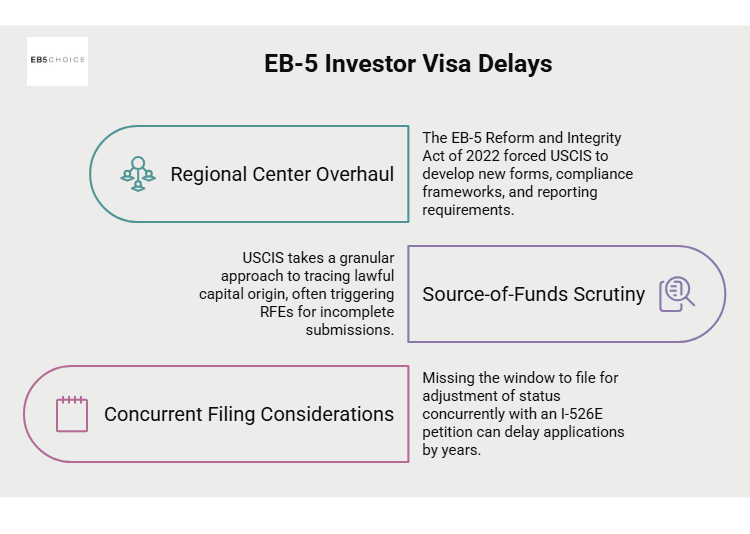
Comparison: Typical EB-5 Processing Under Previous vs. Current Conditions
| Stage | Before 2022 Reform Era | Under Current Conditions |
| I-526 Petition Approval | 18 to 30 months | 24 to 48 months or longer |
| Regional Center Compliance Review | Limited post-approval scrutiny | Ongoing annual reporting and audits |
| Source-of-Funds Review | Standard documentation | Highly granular tracing required |
| Consular Interview (if applicable) | Dependent on post capacity | Significant delays at many posts |
| I-829 Petition (conditions removal) | 24 to 36 months | 36 to 60 months in many cases |
These figures are estimates based on reported processing data and should not be taken as guarantees for any individual case. Processing times vary by case complexity, USCIS workload, and country of chargeability. (Source)
How EB-5 Choice Helps Investors Navigate These Challenges
Navigating the EB-5 program during a period of genuine regulatory complexity requires more than general immigration knowledge. EB-5 Choice is a firm that specializes in guiding investors through every stage of the process, from initial project selection through conditions removal. Here is how the firm helps at each critical point:
1. Program-Specific Expertise Across Every Stage
| What EB-5 Choice Covers | Why It Matters Now |
| Project evaluation and due diligence | Protects investors from weak or non-compliant offerings |
| Securities law coordination (including EB-5 broker dealer) | Supports coordination with qualified professionals on federal securities compliance |
| USCIS petition strategy | Reduces RFE risk through proactive case preparation |
| Long-range immigration planning | Aligns visa strategy with personal and family timelines |
A generalist immigration firm typically cannot coordinate all four of these elements together. EB-5 Choice is built around exactly this intersection.
2. Regional Center and Project Selection Support
Not all regional center projects carry equal risk or regulatory standing. EB-5 Choice helps investors evaluate offerings from the Best EB-5 regional center options currently available by examining:
- Job creation projections and how they are calculated
- Capital structure and repayment terms
- Track record of the developer and regional center operator
- USCIS compliance history under the post-2022 reform framework
This evaluation happens before any capital commitment, giving investors a clearer picture of what they are actually buying into.
3. Source-of-Funds Documentation Preparation
This is one of the highest-friction points under current USCIS policy. Officers now apply a granular, document-intensive review to how investment capital was earned, accumulated, and transferred.
What EB-5 Choice does:
- Reviews the investor’s financial history early in the process
- Identifies documentation gaps before submission
- Builds a fund-tracing package designed to address likely officer concerns proactively
- Reduces the probability of receiving an RFE caused by avoidable evidentiary gaps
Investors who arrive at USCIS with an incomplete source-of-funds record face a high likelihood of delay. This preparation stage is where EB-5 Choice adds some of its most tangible value.
4. Full EB-5 Visa to Citizenship Pathway Guidance
The EB-5 visa to citizenship journey is long under any conditions. EB-5 Choice helps investors understand how current policy shifts affect each stage of that journey, including:
- I-526E petition filing and realistic approval timelines
- Conditional green card and what happens between approval and the two-year mark
- I-829 petition to remove conditions, including job creation evidence requirements
- Naturalization eligibility after conditions are removed and permanent residency is established
Rather than treating each stage as a standalone transaction, EB-5 Choice approaches the full arc of the process as a connected strategy, which is especially important when policy conditions are shifting mid-journey.
At a Glance: What EB-5 Choice Brings to the Table
| Challenge Investors Face | EB-5 Choice’s Role |
| Selecting a compliant, credible project | Regional center and project vetting support |
| Meeting USCIS source-of-funds standards | Proactive documentation preparation |
| Understanding current processing timelines | Policy-informed expectation setting |
| Navigating post-reform regulatory requirements | Program-specific compliance guidance |
| Planning across the full residency pathway | End-to-end EB-5 visa to citizenship strategy |
Working with a firm that understands the full ecosystem of the program is increasingly the difference between a case that moves and one that stalls. That is the core value EB-5 Choice is built to deliver.
For structured guidance on your EB-5 journey, contact EB-5 Choice today.
Practical Steps for Applicants Dealing With Delays
If you are applying for immigration benefits or already in the process, these practical steps can help you manage delays more effectively.
Monitor Your Priority Date
Check the Visa Bulletin monthly, as eligibility dates can move forward or backward. Staying informed helps you act quickly when your category becomes current.
Respond to RFEs on Time
Provide complete and timely responses to any Request for Evidence (RFE). Consider qualified legal guidance to avoid preventable delays.
Consider TEA Investment Options
A TEA investment may qualify for a lower minimum investment threshold. Eligibility depends on the project’s location and current USCIS TEA designation.
Keep Complete Records
Maintain copies of all applications, receipts, supporting documents, and USCIS correspondence in case questions arise later.
Do Not Ignore Long Delays
Silence does not necessarily mean approval. A qualified representative can monitor your case and determine when further inquiries may be appropriate.
Conclusion
The U.S. immigration system is under more administrative pressure than it has been in decades, and Green Card Processing Delays are not a temporary blip but a reflection of structural legal constraints, shifting adjudication standards, and the absence of legislative reform. For investor-based applicants, the EB-5 program remains a sound pathway, but the margin for error is thinner than it was. Documentation must be thorough, project selection matters, and working with advisors who understand the full ecosystem of the program is increasingly the difference between a case that moves and one that stalls.
Frequently Asked Questions
1. Why are green card applications taking longer than before?
Recent executive actions, stricter vetting, and rising RFE rates have slowed adjudications across every visa category. USCIS staffing has not kept pace with rebounding application volumes.
2. Which green card categories are most affected?
Employment-based categories, particularly EB-2 and EB-3 for applicants from India and China, face the longest waits. Family-based and investor-based categories have also seen slower processing.
3. Do new immigration policies affect EB-5 investors too?
Yes. USCIS has increased scrutiny of source-of-funds documentation and regional center compliance. I-526E processing times have lengthened under current workload and post-reform requirements.
4. Can anything speed up a delayed application?
Premium processing is available for certain petitions but does not guarantee approval. Complete filings and prompt RFE responses remain the most effective way to avoid added delays.
5. What happens if the visa bulletin retrogresses mid-application?
Your case stays pending but cannot be approved until your priority date becomes current again. You do not need to refile.
6. Are consular processing delays separate from USCIS delays?
Yes. Applicants outside the U.S. face additional delays at embassies still clearing pandemic backlogs. Interview wait times in some countries stretch 18 months or longer.
7. Is EB-5 still worth pursuing given current delays?
For many investors, yes. EB-5 remains one of the more stable pathways available, provided investors approach it with realistic expectations and proper professional guidance.