

For investors seeking the protection of the EB-5 grandfathering provision, timing is critical. Qualifying Regional Center petitions filed on or before September 30, 2026, will retain statutory grandfathering protection, meaning USCIS must continue adjudicating those petitions even if the Regional Center Program later lapses or expires.
Because this protection depends on filing by the cutoff date, investors should begin preparing well in advance, particularly where source-of-funds documentation, project selection, and fund transfers may require significant time.
What Grandfathering Really Means for Your Petition
Grandfathering is a statutory shield written into the EB-5 Reform and Integrity Act. When Congress created the current program framework, it added language that locks in pending cases.
The RIA includes a grandfathering provision designed to preserve the continued adjudication of qualifying Regional Center petitions filed on or before the cutoff, even if the program later lapses or expires. If lawmakers let the Regional Center Program lapse, or delay renewing it, or renegotiate its terms, your already-filed case does not get frozen or thrown out. It moves forward.
This protection is particularly important given the Regional Center Program’s history of temporary lapses and periodic reauthorization by Congress. Investors have watched the program pause before, leaving pending applicants uncertain about their status. The grandfathering provision was written specifically to remove that fear for anyone who files in time. It turns a program that once felt politically fragile into something far more predictable for those who act early enough.
There is one distinction worth holding onto. The program itself carries authorization through September 30, 2027, but the filing cutoff for grandfathering protection lands a full year earlier, on September 30, 2026. Those two dates get confused constantly. Missing the earlier one means giving up the legal safety net, even though the program may technically still be running. (Source)
What Does the EB-5 Grandfathering Deadline Actually Change for Filing Strategy?
Here is the practical problem. A well-prepared petition is not something you throw together in a weekend. Source-of-funds documentation can take several months to assemble, particularly when the funding history is complex. The overall preparation timeline varies depending on the investor’s source of funds, project selection, transfer logistics, and legal review.
Work backward from that math and the picture gets urgent. An investor who begins in late 2026 may not have a complete, fillable package before the cutoff passes. The EB-5 Grandfathering Deadline is not a date to start by. It is a date to finish by.
Investors pursuing a US green card through investment often underestimate how long the earliest stages take. Choosing a project, transferring capital across borders, and documenting the lawful origin of every dollar are all steps that resist being rushed. Starting early is not about being cautious for its own sake. It is about leaving enough runway to file a clean petition rather than a hurried one.
Learn about common EB-5 Source-of-Funds Mistakes that investors should avoid when preparing their petition.
Filing Before Versus After the Cutoff
| Factor | Petition filed on or before Sept 30, 2026 | Petition filed after Sept 30, 2026 |
| Program-lapse protection | Yes, statutory grandfathering applies | No protection if program lapses |
| Processing if program expires | USCIS must continue adjudicating | Case may stall or be affected |
| Certainty for the investor | High, position locked in | Lower, exposed to political risk |
| Recommended action window | Prepare now to finish in time | Fewer safeguards, more risk |
(Source)
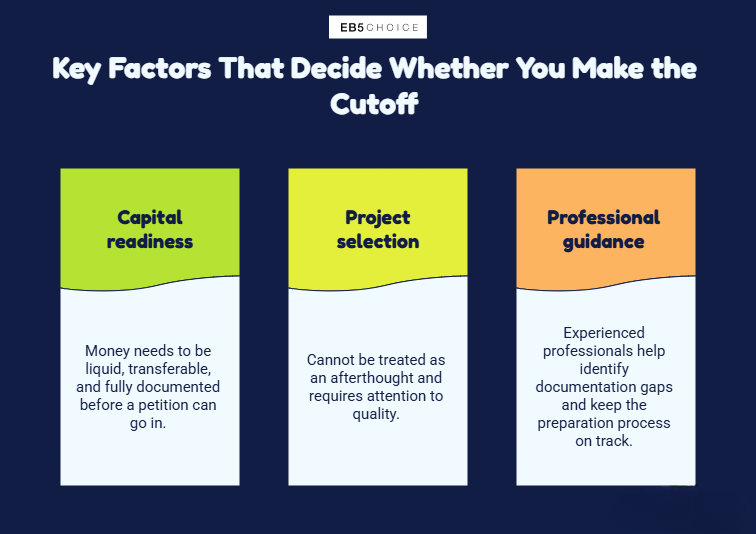
Key Factors That Decide Whether You Make the Cutoff
Three things tend to determine whether an investor files on time. The first is capital readiness. Money needs to be liquid, transferable, and fully documented before a petition can go in. The second is project selection, which cannot be treated as an afterthought. The third is professional guidance, because the details of a compliant filing are unforgiving.
Experienced EB-5 professionals can help identify documentation gaps early, coordinate filing steps, and keep the preparation process on track, mostly by knowing where filings usually get stuck and heading off those problems before they cost you weeks. They help sequence the source-of-funds work, flag documentation gaps early, and keep these filing on a schedule that respects the cutoff.
Project quality deserves equal attention. The best EB-5 projects tend to share a few traits: transparent job-creation modeling, a credible repayment structure, an experienced developer, and clear reporting. A strong project protects both your immigration outcome and your capital, since your petition depends on the project creating the required jobs.
Considerations Investors Sometimes Overlook
Not every part of this decision is about the deadline. Capital in an EB-5 investment is at risk by law, so the EB-5 return on investment varies widely from one project to another and is never guaranteed. Some offerings prioritize capital preservation and a modest yield, while others carry more upside and more uncertainty. Weighing that trade-off honestly is part of choosing well, and it should never be rushed simply to beat a date.
Practical Steps to Take Now
Begin with your source of funds, because it is almost always the slowest piece. Gather bank records, sale documents, tax filings, and any evidence tracing where your capital originated. Start conversations with immigration counsel and a qualified project sponsor in parallel rather than in sequence. Set an internal filing target that sits comfortably ahead of September 30, 2026, so that unexpected delays do not push you past it. Treating the cutoff as your true deadline, with a buffer built in, is the single most reliable way to secure grandfathering protection.
Want to secure grandfathering protection? Learn how to prepare your I-526E petition before the September 30, 2026, cutoff.
Closing Thought
The value of acting early here is not hype, it is arithmetic. The EB-5 Grandfathering Deadline rewards investors who give themselves enough time to file a clean, well-documented petition before September 30, 2026. Filing after the cutoff means giving up statutory grandfathering protection and may expose the petition to greater uncertainty if the Regional Center Program later lapses or expires. The investors who benefit most are simply the ones who started while the runway was still long.
Connect With EB-5 Choice Today
Frequently Asked Questions
Does grandfathering protection apply to derivative applicants?
Yes. When the principal investor files a qualifying petition on or before September 30, 2026, the protection extends to the derivative family members included in that petition, typically a spouse and unmarried children under 21. Their eligibility is tied to the principal’s petition, so a timely, complete filing protects the whole family unit.
What happens if the Regional Center Program lapses after I file?
If your qualifying petition was filed on or before the cutoff, USCIS is required to continue processing it even during a lapse. The grandfathering provision was designed for exactly that situation. A later expiration or reauthorization gap does not invalidate a petition that was already properly filed before the deadline.
Is September 30, 2026, the same as the program expiration date?
No. The Regional Center Program is currently authorized through September 30, 2027. The grandfathering filing cutoff falls one year earlier, on September 30, 2026. Filing between those two dates means the program may still run, but you lose the statutory protection.
How early should I really start?
Because preparation commonly takes six to fourteen months, most investors should begin at least a year before the cutoff. Source-of-funds documentation is the usual bottleneck. Starting in parallel on funds, project selection, and legal review gives you the best chance of filing a complete petition well ahead of the deadline.
Can I still invest after the deadline passes?
Yes, EB-5 investment remains possible after September 30, 2026, as long as the program is authorized. What changes is the safety net. Petitions filed after the cutoff do not carry grandfathering protection, so they are more exposed if the program later lapses or its terms shift.