


If you’re an EB-5 investor approaching the final stage of your immigration journey, finding the best I-829 filing service is the single most important decision you’ll make before securing your permanent green card. After years of patience navigating the EB-5 application process, meeting capital requirements, and waiting through the conditional green card period and the I-829 petition is your final step toward permanent U.S. residency. The professional service you choose can make all the difference. This guide walks you through everything you need to consider to protect your investment and immigration goals.
What Is I-829 and Why Does It Matter?
The I-829 (Petition by Investor to Remove Conditions on Permanent Resident Status) is filed during the 90-day window before your conditional green card expires. Its purpose is to prove to USCIS that you met all the conditions attached to your EB-5 visa, including that your investment was sustained, that the required jobs were created (or are expected to be created), and that your capital was placed at risk throughout the two-year period. For many investors, this petition is the final gateway to achieving U.S. citizenship through the EB-5 program, making it far more than a bureaucratic formality.
A denial at this stage isn’t just an immigration setback. It can threaten your legal status in the United States and complicate the recovery of your investment. The stakes are simply too high to treat this filing casually.
Who Can File Your I-829?
Not every professional who helped you with your initial EB-5 petition is the right person for your I-829. You have several options:
Immigration Attorneys
Immigration Attorneys are the gold standard. A licensed attorney can provide legal advice, handle complications such as RFEs (Requests for Evidence), and represent you before USCIS if issues arise. Look for attorneys with specific EB-5 I-829 experience, not just general immigration practice.
For more information, read our blog on the Role of Attorneys in EB-5
EB-5 Specialized Law Firms
EB-5 Specialized Law Firms often have dedicated teams who manage I-829 filings at scale, particularly for regional center investors. Their experience with common evidence packages and USCIS expectations can be a major advantage.
Document Preparation Services
Document Preparation Services can help compile and organize paperwork but are legally prohibited from providing immigration advice. For a petition as complex and high-stakes as the I-829, relying solely on a document prep service is a significant risk.
Regional Center Legal Teams
Regional Center Legal Teams sometimes offer coordinated I-829 support for their investors. While convenient, ensure any attorney involved represents your interests, not just the regional center’s.
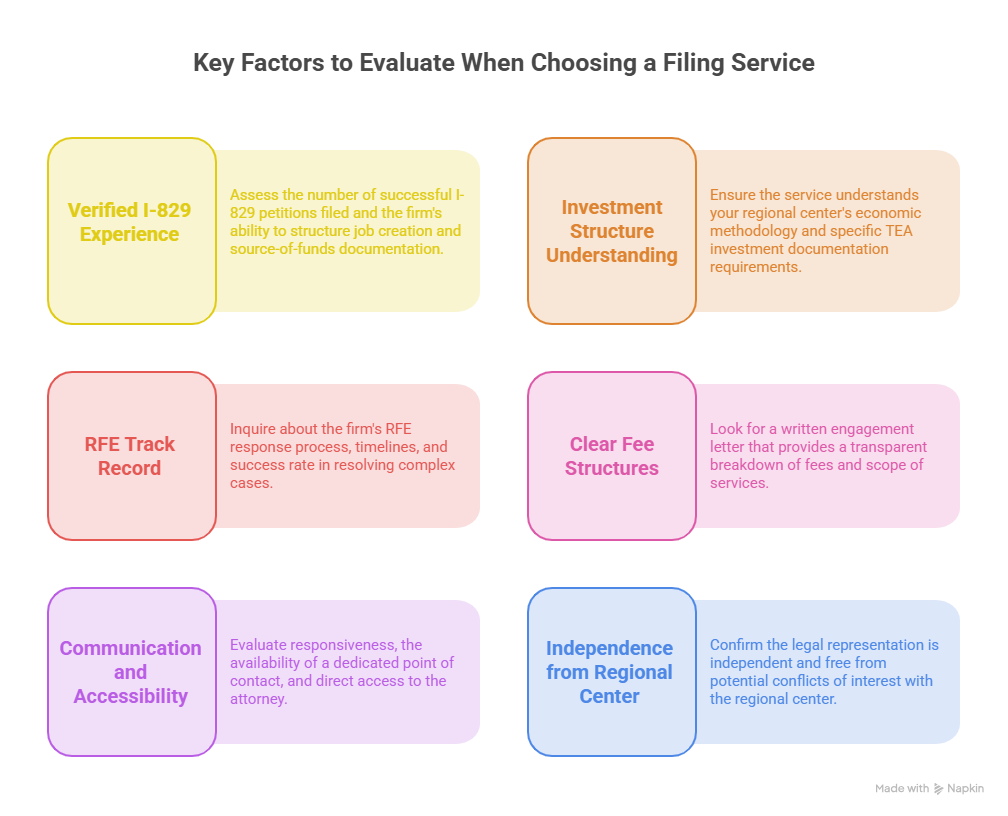
Key Factors to Evaluate When Choosing a Filing Service
1. Verified I-829 Experience
Ask directly: how many I-829 petitions has this attorney or firm successfully filed? The I-829 is not a routine immigration form. Evidence requirements for regional center investors differ substantially from those for direct investment investors. A firm that handles dozens of I-829s each year will know how to structure the job creation documentation, source-of-funds evidence, and sustainment proof in a way that anticipates USCIS scrutiny.
2. Understanding of Your Regional Center or Investment Structure
If you invested through a regional center, your I-829 relies heavily on the center’s economic methodology and job creation data. Your filing service should understand how to translate that data into a compelling petition and know what to do if the regional center’s documentation is incomplete or outdated. This is especially critical for investors who structured their capital through a TEA investment, as targeted employment area designations add another layer of documentation that must be accurately reflected in your filing.
3. Track Record with RFEs and Complex Cases
Even well-prepared I-829 petitions can receive a Request for Evidence. Ask your prospective filing service about their RFE response process, their average response timelines, and their success rate in resolving RFEs favorably. A firm that has never handled an RFE is not a firm prepared for real-world USCIS practice.
4. Clear Fee Structures
I-829 legal fees can range from a few thousand dollars to considerably more depending on case complexity. Be cautious of services that provide no clear breakdown of fees, charge separately for every document, or have vague language about what’s included. A reputable firm will give you a written engagement letter outlining scope of services and fees before you commit.
5. Communication and Accessibility
You’ll likely have questions throughout the I-829 process, which can stretch 12 to 24 months or longer. Evaluate how responsive a firm is before you hire them. Do they assign a dedicated point of contact? Will you have direct access to the attorney, or only to paralegals? Clear, consistent communication is a non-negotiable quality in a high-stakes filing service.
6. Independence from Your Regional Center
This is a point many investors overlook. If your filing service has a financial relationship with your regional center, there is a potential conflict of interest. Your attorney’s job is to represent you and not the regional center, especially if the regional center’s job creation evidence is inadequate or the project encountered difficulties. Always confirm that your legal representation is independent.
For More information, Read our guide on evaluating an EB-5 regional center before you invest
Warning Signs You Should Never Ignore
Guarantees of approval
No legitimate attorney can guarantee USCIS will approve your petition. Anyone who does is either misleading you or doesn’t understand immigration law.
One-size-fits-all pricing with no case assessment
Every I-829 is different. A firm that quotes a flat fee without reviewing your case history doesn’t understand its complexity.
No licensed attorney on file
Document prep services and non-attorney “immigration consultants” cannot legally represent you before USCIS. Confirm that a licensed immigration attorney will be responsible for your petition.
Unfamiliarity with your specific investment
If a firm cannot articulate how your type of EB-5 investment (regional center vs. direct, the specific industry, the job creation model) affects your I-829 evidence requirements, or fails to address your EB-5 return on investment expectations alongside immigration outcomes, look elsewhere.
Pressure to rush
While the I-829 must be filed within a specific window, a reputable firm will ensure the petition is prepared properly — not rushed. Pressure tactics are a warning sign.
Questions to Ask Before You Hire
When evaluating an I-829 filing service, bring these questions to your initial consultation:
- How many I-829 petitions have you filed in the past three years?
- What is your experience with petitions from investors in my type of regional center (or direct investment)?
- How do you handle USCIS Requests for Evidence?
- Who will be my primary point of contact, and how often will I receive updates?
- What documentation will you need from me, and what will you obtain from the regional center?
- Do you have any financial relationship with regional centers?
- What happens if my petition is denied? Do you offer appeals or motion practice?
The answers to these questions will tell you far more than any website or marketing brochure.
Conclusion
The I-829 filing window opens 90 days before your conditional green card expires. Many experienced EB-5 attorneys recommend beginning to gather documentation and engage a filing service at least six months before that window opens. Regional centers can take time to compile job creation reports, economic analyses, and project documentation, and you don’t want a delay on their end to compress your filing timeline.
Starting early also gives you time to shop for the right representation rather than settling for whoever is available under deadline pressure.
Frequently Ask Questions
Q1. What is the best I-829 filing service for EB-5 investors?
The best I-829 filing service is one that has verified EB-5 experience, a licensed immigration attorney on file, transparent fees, and a proven track record of successful petitions and RFE responses.
Q2. When should I file my I-829 petition?
You must file your I-829 within the 90-day window before your conditional green card expires. However, it is strongly recommended to begin preparing your documentation at least six months in advance.
Q3. Can a document preparation service file my I-829?
No. Document preparation services cannot legally provide immigration advice or represent you before USCIS. A licensed immigration attorney should always be responsible for your I-829 petition.
Q4. How does a TEA investment affect my I-829 filing?
A TEA investment adds an additional layer of documentation to your I-829 petition. Your filing service must accurately reflect the targeted employment area designation and ensure all supporting evidence is properly included.
Q5. What happens if my I-829 petition is denied?
A denial can threaten your legal status in the United States and complicate the recovery of your investment. A qualified attorney can file a motion to reopen or appeal the decision on your behalf.
Q6. How long does the I-829 approval process take?
Processing times can range from 12 to 24 months or longer depending on USCIS workload and case complexity. Your conditional green card is automatically extended while your petition is pending.
Q7. What is the difference between a regional center and direct EB-5 investment for I-829 purposes?
Regional center investors rely on the center’s economic methodology and job creation data, while direct investors must provide their own detailed job creation evidence. Each requires a different documentation approach.
Q8. Can I switch attorneys before filing my I-829?
Yes. You have the right to choose any licensed immigration attorney for your I-829 regardless of who handled your initial EB-5 petition. Starting the transition early ensures no delays in your filing timeline.
Q9. What is EB-5 return on investment and does it affect my I-829?
EB-5 return on investment refers to the financial gains from your EB-5 capital placement. While it does not directly impact your I-829 approval, a good filing service should understand your investment structure fully to present accurate and complete evidence.
Q10. Can the EB-5 program lead to U.S. citizenship?
Yes. A successfully approved I-829 grants you permanent resident status, which is a key step toward U.S. citizenship through the EB-5 program. After meeting the residency requirements, you may apply for naturalization.