


When markets turn volatile and immigration rules shift without warning, families with capital to protect start asking the same question: where can we go that is actually stable? For a growing number of them, the answer lies in EB-5 Visa During Political Uncertainty, which offers a defined investment-based route to U.S. residency instead of a temporary status tied to a job, a lottery, or a foreign government’s next policy move.
In this blog, you’ll learn why the EB-5 visa program is gaining popularity and what investors should know before getting started.
What Exactly Does This Investment Visa Involve?
The EB-5 immigrant investor program was created by Congress in 1990 to bring foreign capital into the U.S. economy while generating jobs for American workers. An investor commits qualifying capital, currently starting at 800,000 dollars for projects in a targeted employment area, into a new commercial enterprise that must create at least ten full-time jobs. In return, the investor, their spouse, and their unmarried children under 21 become eligible for lawful permanent residence. There is no employer sponsor involved and no requirement to manage day-to-day operations if the investment runs through a regional center.
That structure sounds simple on paper, but its real appeal only becomes clear once you look at what else is happening around the world right now.
Need any information read our blog What Is the EB-5 Designation Process? A Complete Guide for New Investors
Why Are Investors Turning to the EB-5 Visa Program During Political Uncertainty?
A few years ago, EB-5 was often described as a niche option for a small pool of wealthy applicants. That has changed. Canada suspended its federal immigrant investor program years back (Source) and never brought it back at any meaningful scale, and several European golden visa programs have tightened their rules or shut their doors to new applicants entirely. When those exits close, demand does not disappear. It moves. A lot of it has moved toward the United States, partly because U.S. immigration through investment still offers something rare: a defined legal process instead of a policy that can be rewritten overnight.
There is also a domestic piece to this story. Skilled professionals on H-1B visas have watched petition fees climb and lottery odds shrink, all while their legal status stays tethered to a single employer. One layoff can put years of planning at risk. For families in that position, EB-5 visa benefits include something the H-1B simply cannot offer: an immigration path that does not depend on staying employed by any particular company.
Key Factors Behind the Shift
A handful of concrete developments explain why interest has accelerated rather than faded.
- The EB-5 Reform and Integrity Act of 2022 created reserved visa categories, setting aside 20 percent of visas for rural area projects, 10 percent for high-unemployment area projects, and 2 percent for infrastructure projects (Source). These set-asides pull from separate visa pools, which can mean shorter waits than the general category.
- Traditional employment-based green card backlogs, particularly for applicants born in India and China, can stretch past a decade because of per-country caps written into immigration law. EB-5’s separate visa allocation sidesteps that specific bottleneck.
- A grandfathering deadline of September 30, 2026, allows investors who file before that date to lock in the current program rules, shielding their case from many future legislative changes.
- Because the program funds private development rather than drawing on taxpayer money, it has kept a level of bipartisan support in Congress that few other immigration categories can claim.
How Does EB-5 Compare to Other Paths to U.S. Residency?
Investors weighing their options often want to see the trade-offs laid out plainly rather than buried in marketing language. Here is a simplified comparison.
| Pathway | Employer Required | Typical Timeline to Green Card | Investment or Fee Level |
| EB-5 Visa Program | No | Roughly 2 to 5 years, faster in reserved categories | 800,000 to 1,050,000 dollars |
| H-1B to Green Card (EB-2/EB-3) | Yes | Can exceed 10 years for high-demand countries | No direct investment, but legal and filing costs apply |
| Golden Visa Programs Abroad | No | Varies widely, often does not lead to citizenship | Ranges from roughly 100,000 to 2 million dollars depending on country |
Among these options, EB-5 remains one of the safest residency options for global investors who want a result that does not hinge on a single employer’s decisions or a foreign government reversing course midstream. That said, it is not without friction, and pretending otherwise would not serve anyone weighing a genuine six or seven figure decision.
What Challenges Should Investors Consider Before Relocating?
No immigration strategy is risk free, and EB-5 is no exception. Before relocating, investors should be aware of the following challenges:
1. Processing Times Can Vary
Processing times still fluctuate depending on USCIS staffing and case volume.
2. Choosing the Right Project Matters
Project quality varies enormously between regional centers, and a poorly vetted project can delay or jeopardize an investor’s petition even when the paperwork is technically correct.
3. Source of Funds Documentation Is Critical
Source of funds documentation, proving exactly where the invested capital came from and how it moved, trips up more applicants than almost any other part of the process.
4. Prepare for Life After Relocating
For families actually relocating to the United States, there are practical adjustments too:
- Tax residency rules change.
- Banking relationships often need to be rebuilt.
- Children may need help transitioning into a new school system.
These are manageable issues, but they deserve real planning rather than an afterthought.
Practical Advice for Investors Considering This Path
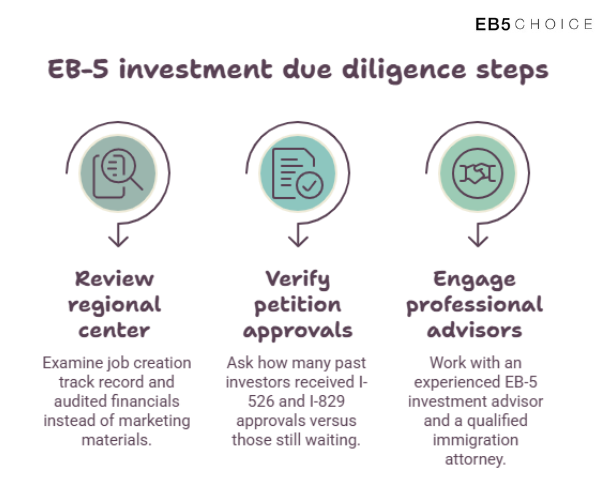
Anyone seriously considering this route should start well before the capital changes hands. Review a regional center’s job creation track record and audited financials, not just its marketing materials. Ask specifically how many past investors have received approvals on their I-526 and I-829 petitions, and how many are still waiting. Working with an experienced EB-5 investment advisor, alongside a qualified immigration attorney, tends to catch structural problems in a project long before they become expensive surprises.
It also helps to think about this as a long-term immigration strategy rather than a transaction. The investment itself is only the opening move. The petition process, the conditional residency period, and the eventual filing to remove conditions all take patience and documentation discipline over several years.
How Does an EB-5 Visa Lead to Citizenship?
Once USCIS approves the initial petition and the investor’s family enters the country, they receive conditional permanent residence for two years. Around the 90 day window before that period ends, the investor files to remove the conditions by proving the investment was sustained and the required jobs were created. Approval at that stage converts the conditional card into a standard 10 year green card.
From there, the path to U.S. citizenship through EB-5 program follows the same route available to any other permanent resident: five years of continuous residence, physical presence requirements, and passing the naturalization test and interview. For investors focused specifically on the EB-5 Visa to citizenship timeline, the realistic total window from initial filing to naturalization eligibility typically runs somewhere between seven and nine years, depending on processing speeds and whether the case falls into a reserved category.
Final Thoughts
Global uncertainty tends to push capital toward whatever looks solid and rule-based, and for a lot of investors right now, that description fits the EB-5 visa program better than the alternatives they have looked at. It will not be the right fit for everyone, and it demands real diligence rather than blind trust in a glossy brochure. But for families who want a documented, legally grounded path to a life in the United States, rather than a status that can be revoked by circumstances outside their control, it remains one of the more dependable options on the table today. If you’re considering this pathway, EB-5 Choice can help you better understand the process and make informed decisions based on your family’s immigration goals.
Frequently Asked Questions
Is the EB-5 program still accepting new applicants?
Yes. The Regional Center Program is currently authorized through September 30, 2027, and USCIS continues to process new petitions. Investors aiming to lock in current program rules should be aware of the earlier grandfathering deadline of September 30, 2026, which applies to petition filing rather than program authorization.
How much does an EB-5 investment cost in total?
The base investment starts at 800,000 dollars for a targeted employment area project or 1,050,000 dollars for a standard project. On top of that, applicants should budget for administrative fees, legal fees, and USCIS filing costs, which together can add tens of thousands of dollars to the total.
Can EB-5 investors bring their families?
Yes. A successful petition covers the investor, their spouse, and any unmarried children under the age of 21 at the time of filing. All qualifying family members receive conditional permanent residence together and follow the same path toward a standard green card.
Is EB-5 faster than other U.S. permanent residency by investment paths?
It depends on the category. Reserved visa categories under the 2022 reform law tend to move faster than the general EB-5 pool, and both are typically faster than employment-based categories affected by per-country backlogs, especially for applicants from high-demand countries.
What is the biggest mistake investors make with EB-5?
Choosing a project based on projected returns alone, without verifying the regional center’s job creation history or requesting documented proof of past petition approvals. A financially attractive project that fails to meet job creation requirements can delay or derail the entire immigration case.